sacrifice-4
Explanation
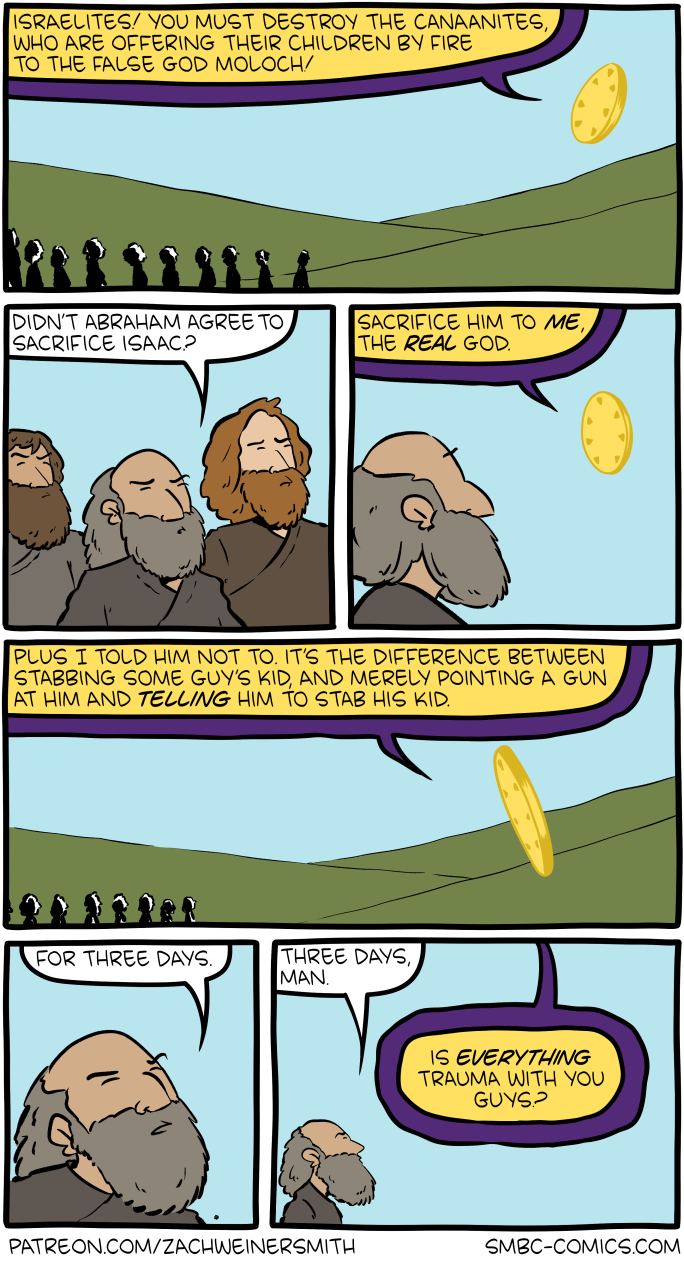
The comic presents a scene from the Hebrew Bible/Old Testament, depicting what appears to be a conversation among ancient Israelites about sacrifice and divine commands.
In the first panel, someone declares: "Israelites! You must destroy the Canaanites who are offering their children by fire to the false god Moloch!" This references the biblical prohibitions against child sacrifice to Moloch (or Molech), a deity associated with the Canaanites and other ancient Near Eastern peoples, condemned repeatedly in the Hebrew Bible (Leviticus 18:21, 20:2-5, Deuteronomy 12:31, etc.).
The next panels reference two other famous biblical stories involving potential child sacrifice. One person mentions that God asked Abraham to sacrifice Isaac (Genesis 22, the Binding of Isaac or "Akedah"), and another suggests sacrificing someone "to the real God." Then comes the reminder that God told Abraham NOT to do it -- that the whole point was that it was a test of faith, and God intervened to prevent the actual sacrifice.
The punchline comes in the final panels. After three days of theological discussion, one character simply says "Dude." Another asks: "Is everything trauma with you guys?"
The humor works by highlighting the uncomfortable proximity between the condemned practice of child sacrifice to Moloch and the celebrated biblical narrative of Abraham's near-sacrifice of Isaac. While theologians have long distinguished these -- the Akedah is about obedience and faith, with God ultimately preventing the sacrifice -- the comic points out that from a modern psychological perspective, the Abraham story is still deeply disturbing: a father was willing to kill his son because a voice told him to. The final line about "trauma" applies modern therapeutic language to ancient religious narratives, suggesting that the entire tradition is processing collective trauma through its foundational stories.