the-other-side-of-the-chessboard-2

Explanation
The Joke
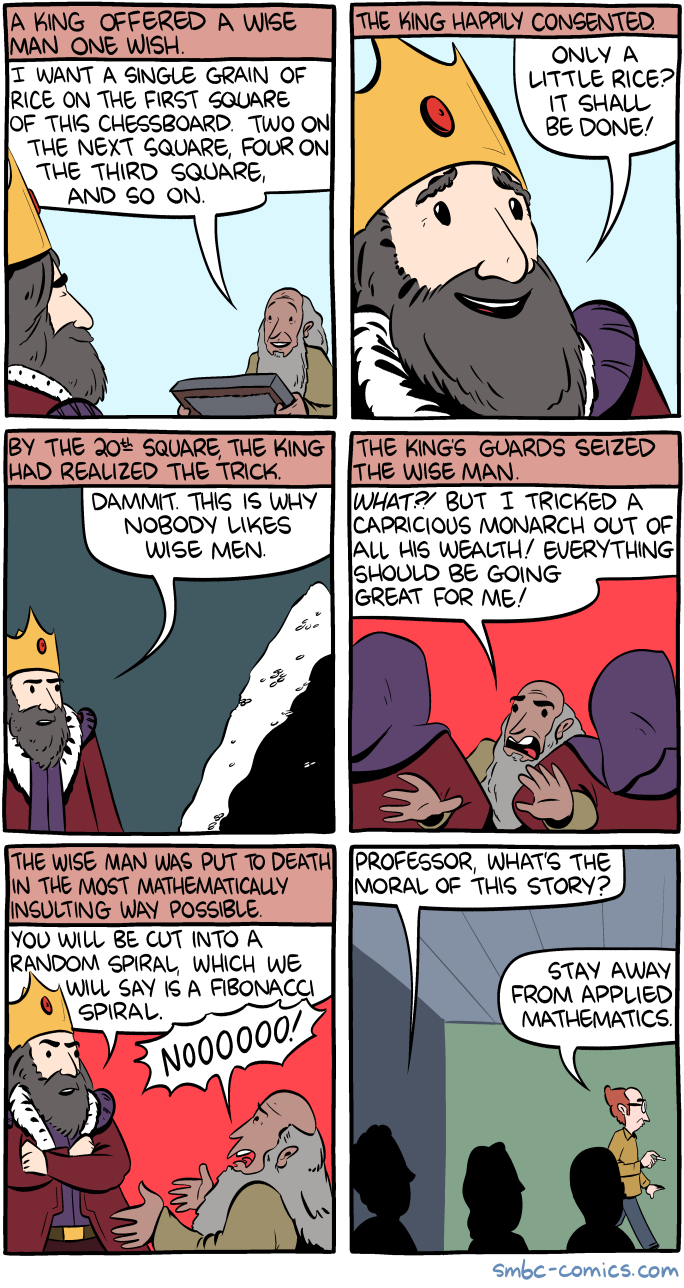
The comic retells the classic "wheat and chessboard" legend: a wise man offers a king one wish -- a single grain of rice on the first square of a chessboard, two on the next, four on the third, and so on, doubling each time. The king, not understanding exponential growth, happily agrees, thinking it is only a little rice. By the 20th square, the king has realized the trick -- the total amount of rice grows astronomically.
But this version of the story goes beyond the usual telling. The king's guards seize the wise man, who protests: "What?! But I tricked a capricious monarch out of all his wealth! Everything should be going great for me!" The wise man is then put to death "in the most mathematically insulting way possible" -- he is to be cut into a random spiral, which they will call a Fibonacci spiral. The wise man screams "Nooooooo!" In the final panel, a professor is asked the moral of the story, and he answers: "Stay away from applied mathematics."
The Humor
The comic subverts the usual moral of the wheat and chessboard problem (which is typically about the surprising power of exponential growth). In most versions, the wise man is presented as clever and the king as foolish. Here, the comic asks the obvious follow-up question that the legend always ignores: what happens when an absolute monarch realizes he has been tricked? The wise man's indignant surprise that his scheme backfired is hilarious because he seems to have expected that outsmarting a king would have no consequences. The punishment -- being cut into a Fibonacci spiral -- is a mathematically themed execution that adds insult to injury by using a different famous mathematical concept to kill someone who weaponized exponential growth. The final moral, "stay away from applied mathematics," suggests that pure math is safe but applying it to the real world (especially to trick kings) gets you killed.
References
The wheat and chessboard problem is an ancient legend, often attributed to the invention of chess in India. The total number of grains on all 64 squares would be 2^64 - 1, or about 18.4 quintillion grains -- far more than all the rice or wheat ever produced in human history. The Fibonacci spiral is a spiral that approximates the golden spiral and is derived from the Fibonacci sequence (1, 1, 2, 3, 5, 8, 13...), where each number is the sum of the two preceding ones. It appears frequently in nature (nautilus shells, sunflower seed patterns) and is a staple of popular mathematics. Using it as a method of execution is a darkly creative punishment for a mathematician.