the-portrait
Explanation
The Joke
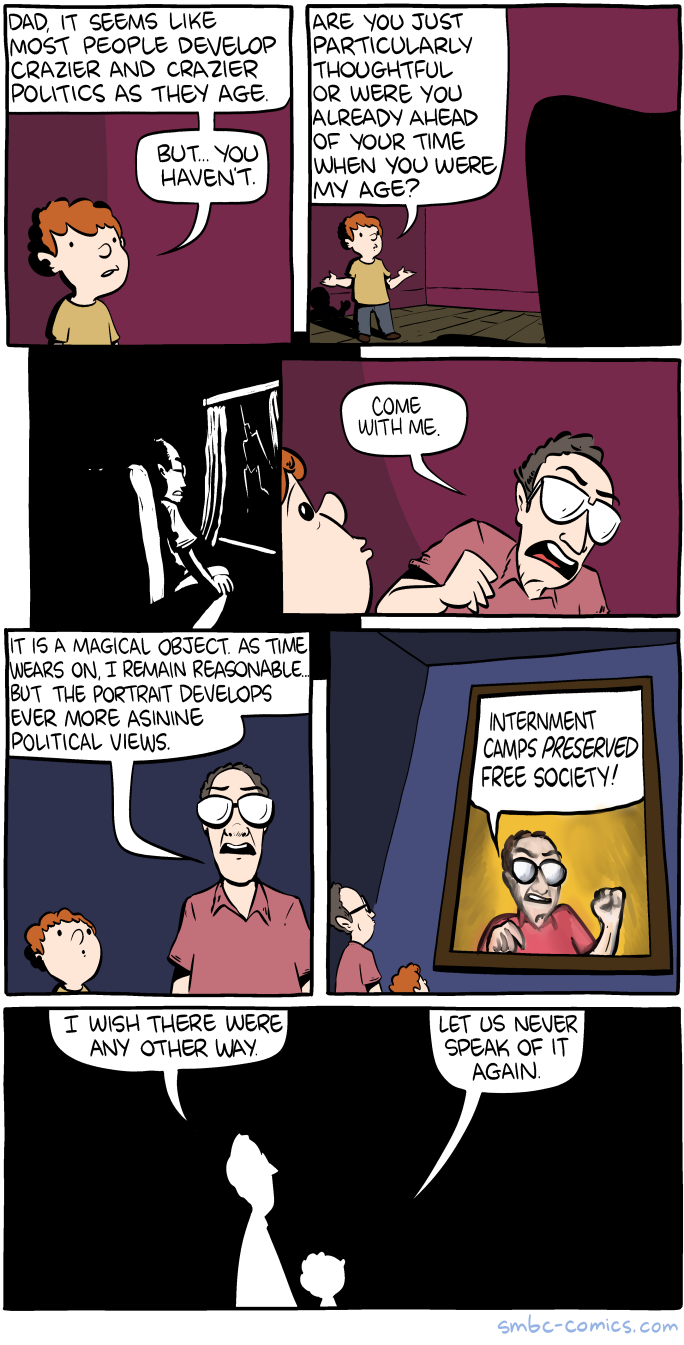
A father observes to his daughter that it seems like most people develop gender and gender politics as they age. The daughter asks whether he is "just particularly thoughtful" or whether he read about it somewhere. He admits he has not thought about it much and says "but you haven''t either" -- to which she replies with something suggesting she has indeed given it more thought. He then says "come with me."
He takes her to see a magical portrait, similar to the concept in "The Picture of Dorian Gray." However, instead of aging in the subject''s place, the portrait develops ever more extreme political views. The portrait has become radicalized, displaying signs about "internment camps" and extremist slogans. The father''s response -- "I wish there were any other way" -- and the daughter''s "let us never speak of it again" suggest they are horrified by what the portrait has absorbed on their behalf.
The Humor
The comic takes the classic Dorian Gray concept -- a magical portrait that absorbs the negative effects of aging -- and applies it to the modern phenomenon of political radicalization over time. Instead of physical decay, the portrait absorbs the person''s tendency to develop increasingly extreme political opinions as they age. The horror is not wrinkles and gray hair, but angry political views and calls for internment camps.
This satirizes the observation that people often become more politically rigid and extreme as they age, treating political radicalization as an inevitable and horrifying byproduct of aging -- something so terrible that you would need a magical portrait to absorb it for you. The fact that both father and daughter are disturbed by the portrait''s views suggests that political extremism is presented as being worse than physical aging.
References
- The Picture of Dorian Gray (1890) by Oscar Wilde tells the story of a man whose portrait ages and decays in his place, allowing him to remain eternally young and beautiful while his sins are reflected in the painting. The comic repurposes this concept for political views rather than physical aging.