Villainy
Explanation
The Joke
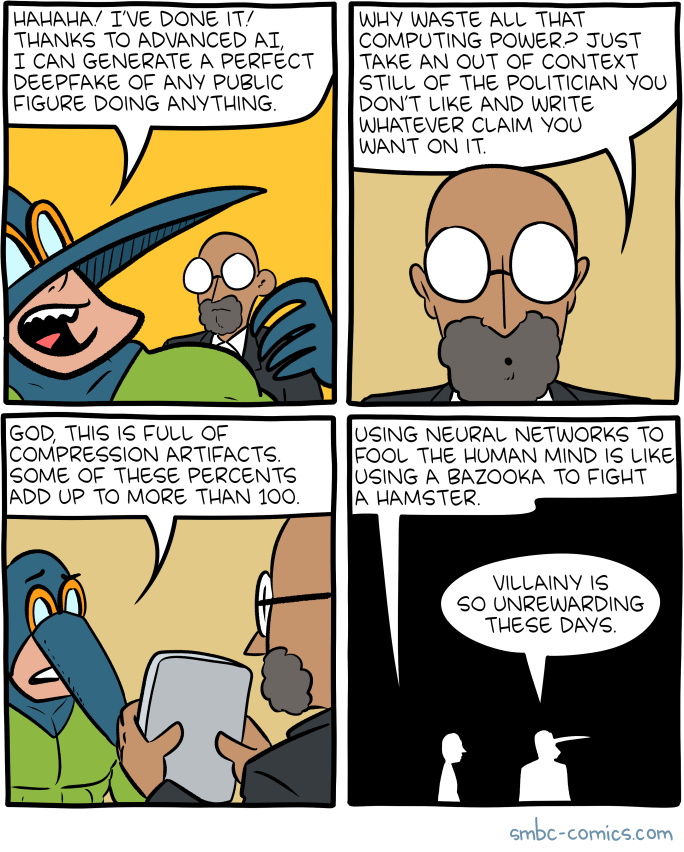
A supervillain (wearing a cape and mask) triumphantly declares: "Hahaha! I've done it! I've managed to disguise as a politician! Now I can do evil without consequence!" A bald character (perhaps an advisor or henchman) responds pragmatically: "Why waste all that disguising yourself? Just use your resources to actually become a politician. Whatever claim you want, just buy it."
The villain objects: "But that's full of red tape and bureaucracy!" The advisor then suggests even more extreme measures: "Some of these 'percents' who serve up their own... using neural networking to bring a bazooka to fight..." The final panel shows a small figure in the distance saying "Villainy is so underwhelming these days," commenting on how real-world corruption has made supervillainy redundant.
The joke is that a traditional comic-book supervillain's schemes pale in comparison to the corruption already available through legitimate political channels. Why bother with an elaborate disguise when you can simply buy political power outright?
The Humor
The comic satirizes the relationship between politics and villainy by suggesting that the political system is already so corrupt that a supervillain's elaborate schemes are unnecessary and even quaint by comparison. The villain wants to disguise himself as a politician to do evil, but his advisor points out that simply becoming a politician through money and influence is far more effective and carries fewer risks.
The punchline -- "Villainy is so underwhelming these days" -- captures the absurd deflation of the villain's grand ambitions. Traditional supervillainy with costumes and evil laughter has been rendered obsolete by the mundane, systemic villainy of real-world politics and money in government. The comic inverts the usual power fantasy of superhero stories by making the villain the sympathetic underdog outclassed by ordinary institutional corruption.
References
The comic draws on the long tradition of supervillain tropes from comic books, where villains create elaborate schemes to gain power. It satirizes real-world issues around money in politics, lobbying, and the revolving door between business and government. The premise echoes the famous observation often attributed to various sources that the difference between a criminal and a politician is that the politician's crimes are legal.