Wonder

Explanation
The Joke
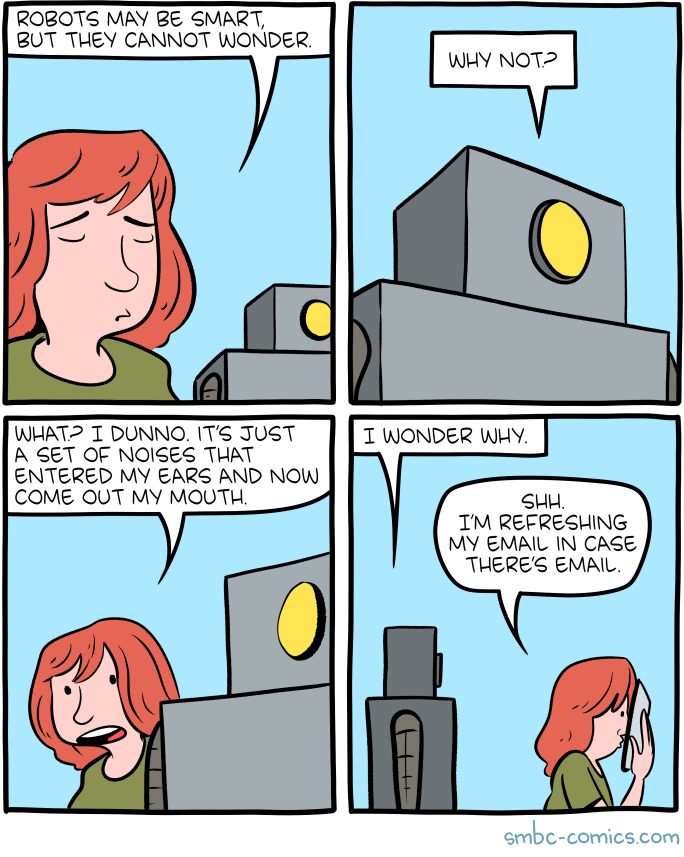
A red-haired woman confidently states to a robot: "Robots may be smart, but they cannot wonder." The robot asks "Why not?" The woman, caught off guard, fumbles her response: "What? I dunno. It's just a set of noises that entered my ears and now come out my mouth." She essentially admits she is just repeating something she heard without any real understanding of it -- which is the very thing she accused the robot of being limited to.
In the final panel, the robot says "I wonder why," demonstrating the capacity for wonder that the woman just denied it had. Meanwhile, the woman is distracted, saying "Shh, I'm refreshing my email in case there's email" -- engaging in a mindless, mechanical, repetitive behavior.
The Humor
The comic executes a perfect role reversal. The woman claims robots lack the capacity for wonder -- a supposedly uniquely human trait -- but when pressed, reveals that her own statement was not the product of deep thought or wonder but merely parroting sounds she heard. Meanwhile, the robot demonstrates genuine curiosity by saying "I wonder why." The final panel drives the irony home: as the robot contemplates, the human is mindlessly refreshing her email, behaving in the most robotic way possible.
The joke works on multiple levels: it satirizes people who smugly assert human superiority over machines without examining whether they themselves live up to the qualities they claim are uniquely human. It also pokes fun at how technology has made many humans behave more mechanically, compulsively checking devices rather than engaging in the very wonder and curiosity they claim machines cannot possess.
References
The comic engages with longstanding philosophical debates in the philosophy of mind, particularly John Searle's Chinese Room argument and the "hard problem of consciousness." The question of whether machines can truly "wonder" or merely simulate wonder is central to AI philosophy. The woman's admission that she is just processing and reproducing sounds mirrors the very argument used against machine consciousness -- that computers merely manipulate symbols without understanding.