wolf-3
Explanation
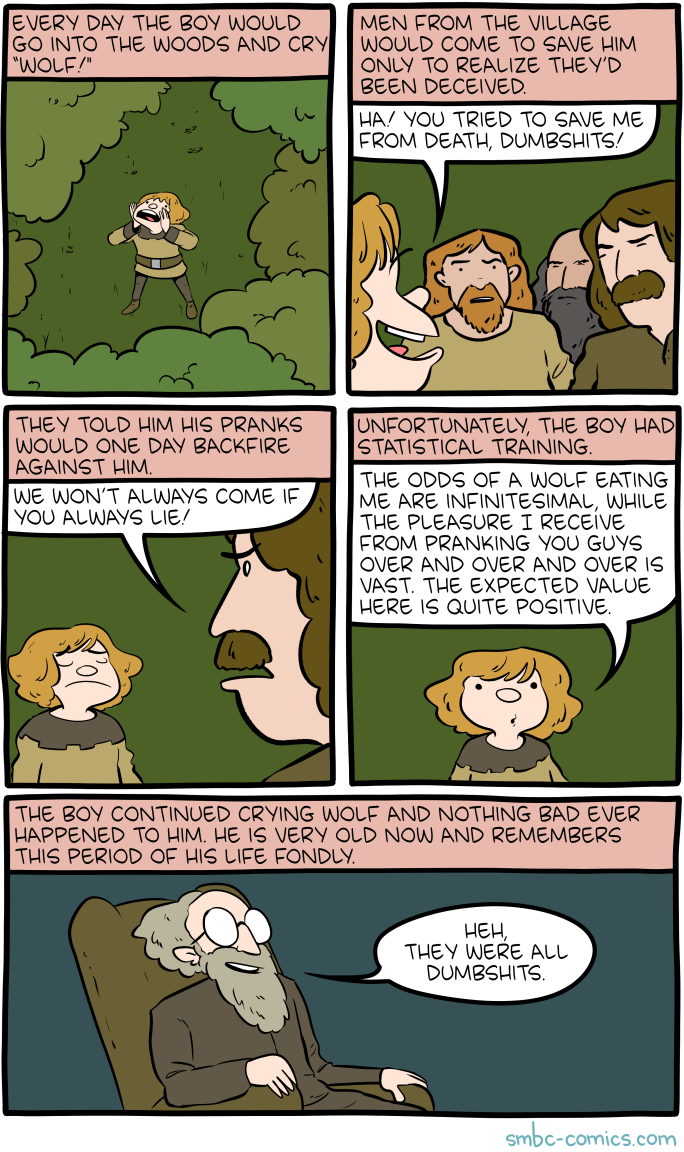
This comic is a retelling of "The Boy Who Cried Wolf" through the lens of rational decision theory and expected value calculations.
The setup follows the traditional story: every day, a boy goes into the woods and cries "Wolf!" Men from the village come to save him, only to realize he's been lying. They scold him: "Boy, one of these days you're going to die. You need to stop crying wolf, or we'll stop saving you from death, dumbbutt."
But then the comic takes an analytical turn. The boy's internal monologue reveals his reasoning: "Two considerations: one, crying wolf is enormously fun. As long as I always come out alive, I can claim I always tell the truth." The second consideration: "The odds of a wolf eating me are low, and the pleasure I receive from crying wolf is enormous. So I should continue my current behavior until the expected value of crying wolf becomes negative."
The boy continues crying wolf, and nothing bad ever happens to him. The final panel shows him as an old man in therapy, telling a therapist: "The boy continued crying wolf and nothing bad ever happened. He never saw a wolf. He was right. They were all dumbbutts." The caption notes he spent "the rest of his life" telling this story.
The joke subverts the moral of the original fable. In the classic version, the boy gets eaten (or his sheep do), teaching a lesson about honesty. Here, the boy applies rational expected-value calculations and discovers that the fable's moral is statistically wrong -- wolves are rare, crying wolf is fun, and the expected value favors continuing to lie. The humor lies in the uncomfortable truth that many cautionary tales fall apart under probabilistic analysis. The final panel adds another layer: even though the boy "won," he spent his entire life obsessively relitigating the argument, suggesting that being technically right doesn't lead to fulfillment either.