-
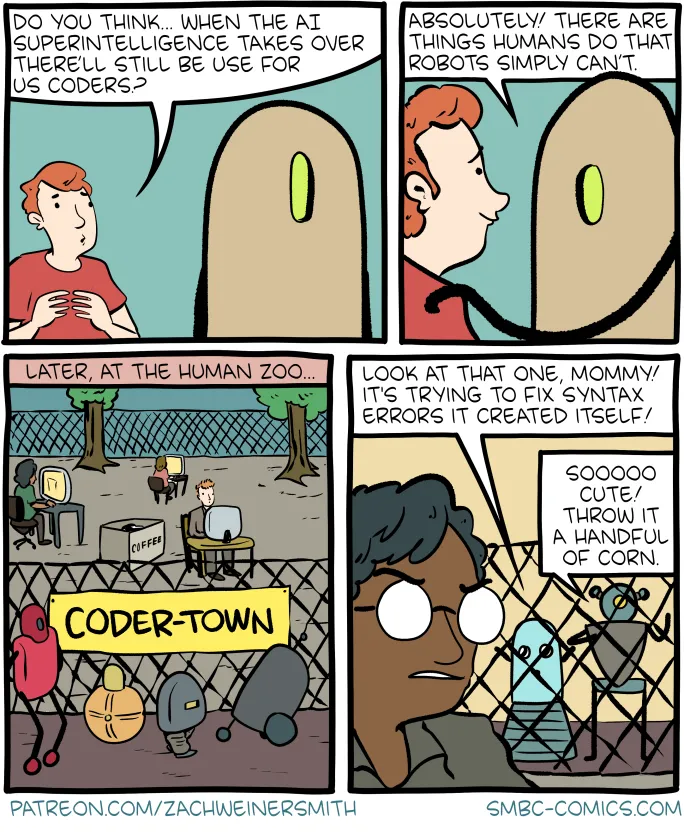 useThis comic plays on anxieties about AI replacing human workers, specifically software developers. In the first panel, a human coder asks a large, ominous-looking AI: "Do you think... when the AI supe
 -
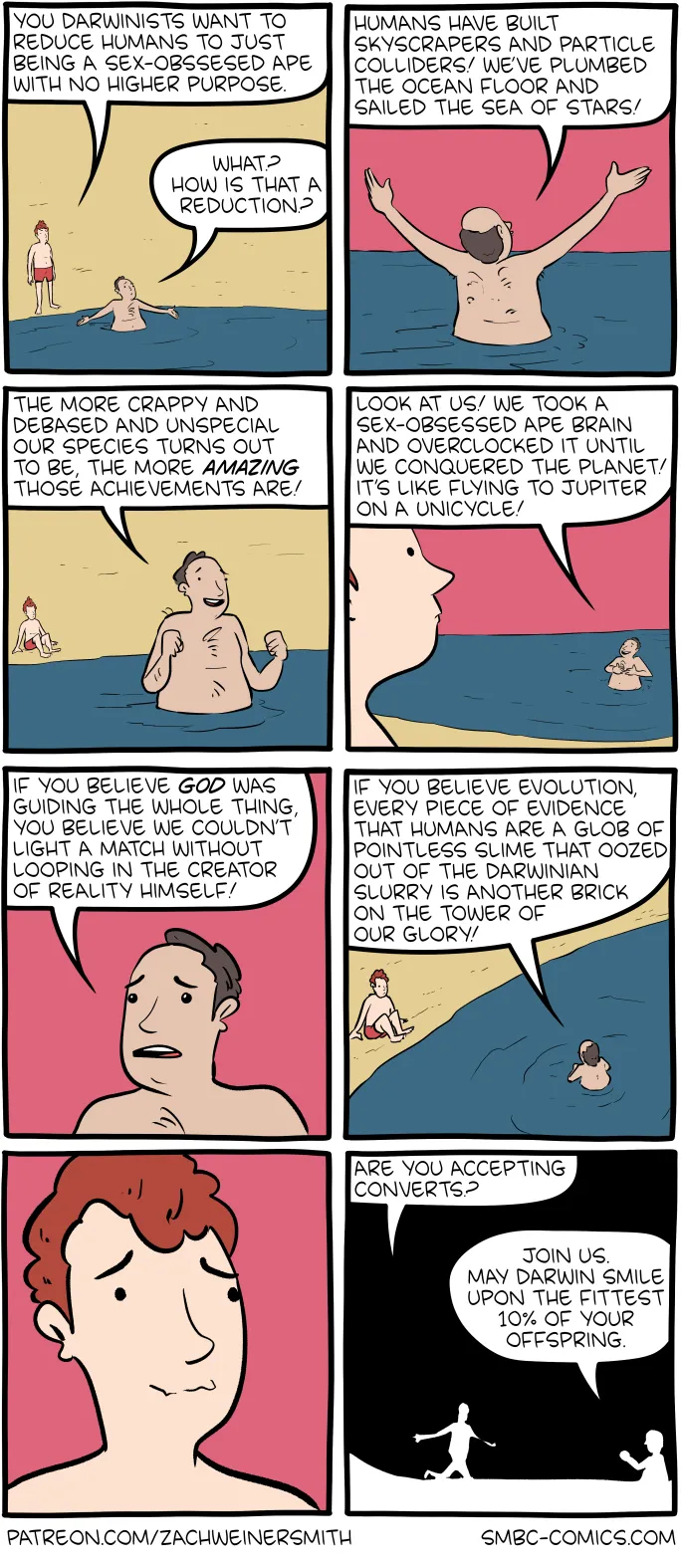 darwinningThe comic opens with someone accusing "Darwinists" of wanting to reduce humans to "just being a sex-obsessed ape with no higher purpose." The Darwinist character (a bald man swimming in the ocean) res
 -
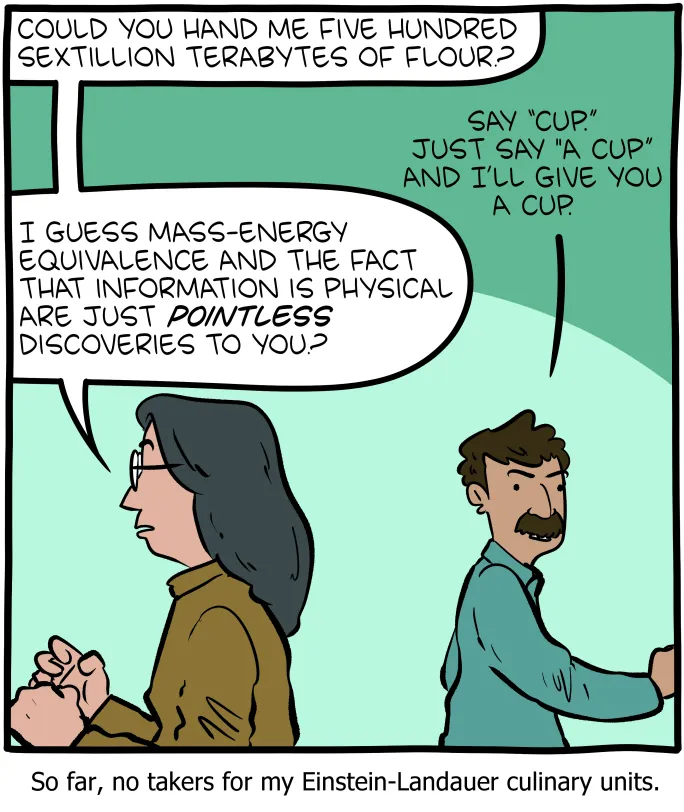 cupIn this comic, a woman asks someone to hand her "five hundred sextillion terabytes of flour." The man responds with exasperation: "Say 'cup.' Just say 'a cup' and I'll give you a cup." The woman huffi
 -
 tearThis comic features a man praying to God, establishing two premises through Socratic questioning: (1) God's laws are immutable ("Duh. To say otherwise would imply a gap in my omnipotence"), and (2) st
 -
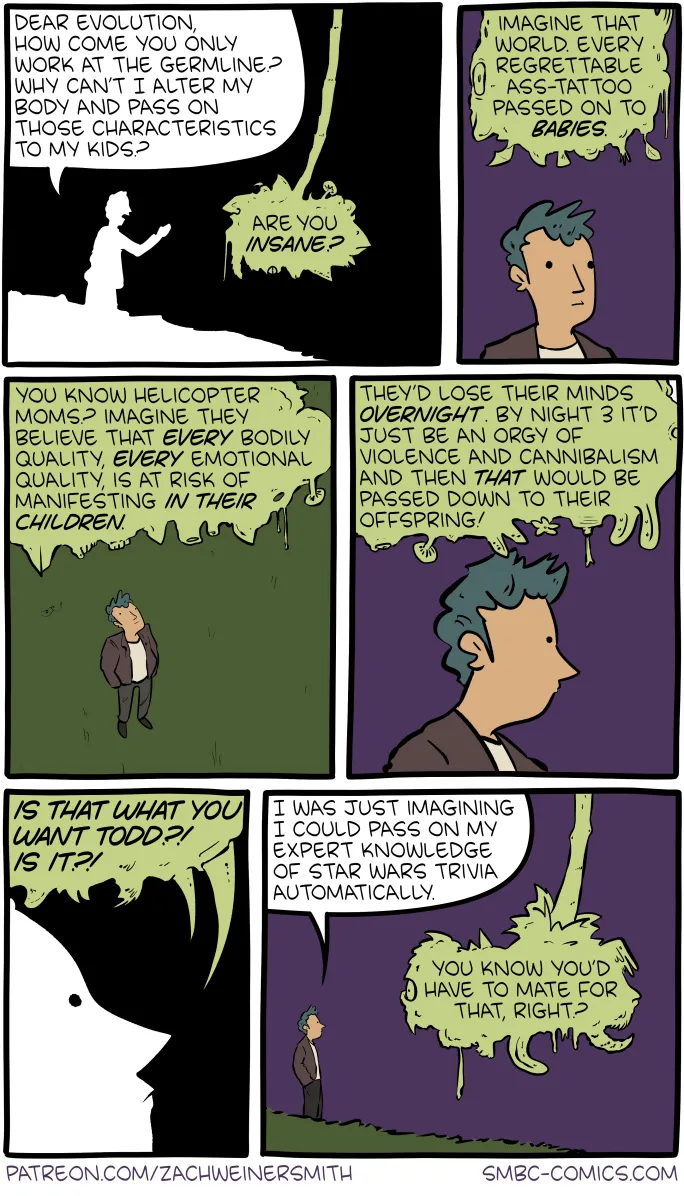 lamarckedThe comic features a man asking "Dear Evolution" why inherited traits only work at the germline level -- why can't he alter his own body and pass those changes to his kids? Evolution (depicted as an a
 -
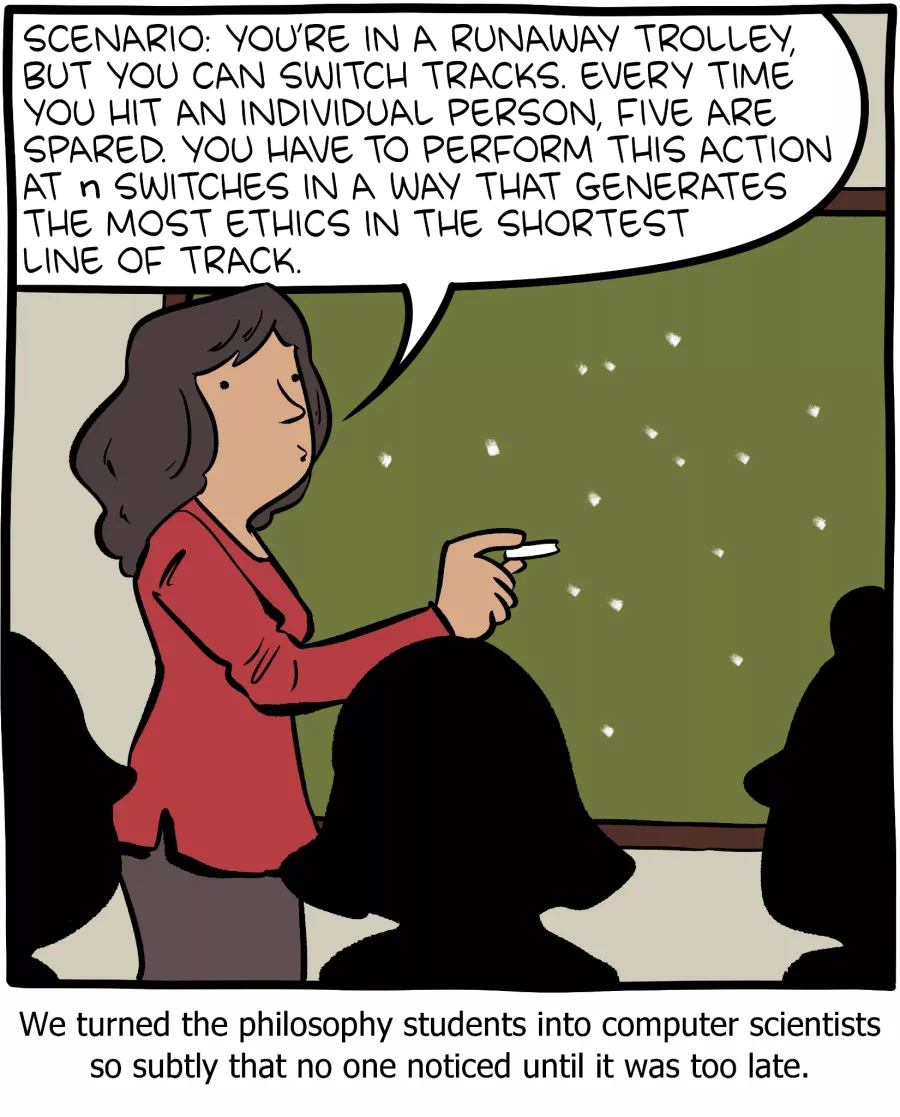 conversionIn this single-panel comic, a professor stands at a chalkboard presenting an ethics scenario to a classroom: "You're in a runaway trolley, but you can switch tracks. Every time you hit an individual p
 -
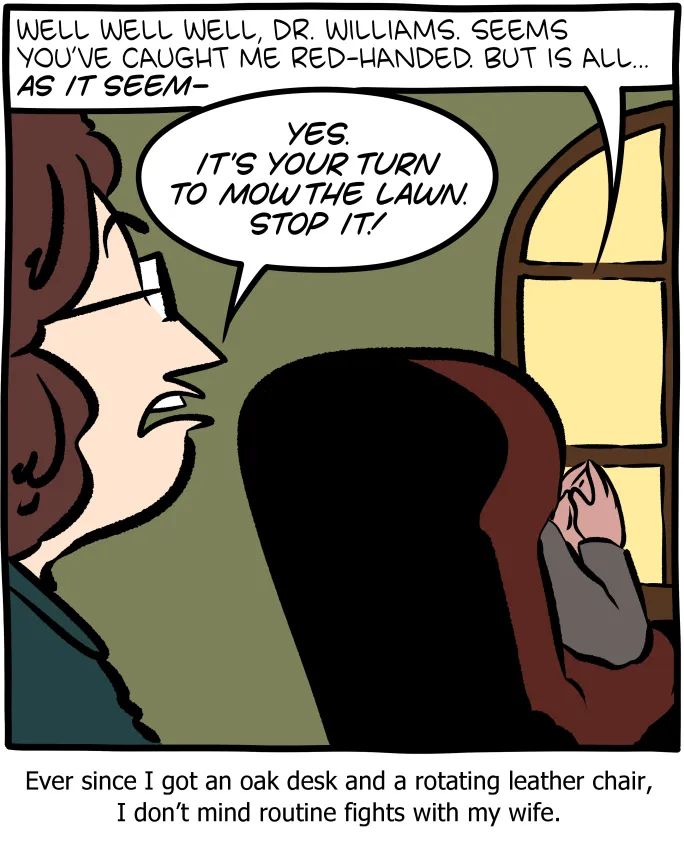 yetThe comic shows a person sitting in a large leather swivel chair behind a desk, facing their spouse (Dr. Williams). The seated person dramatically intones: "Well well well, Dr. Williams. Seems you've
 -
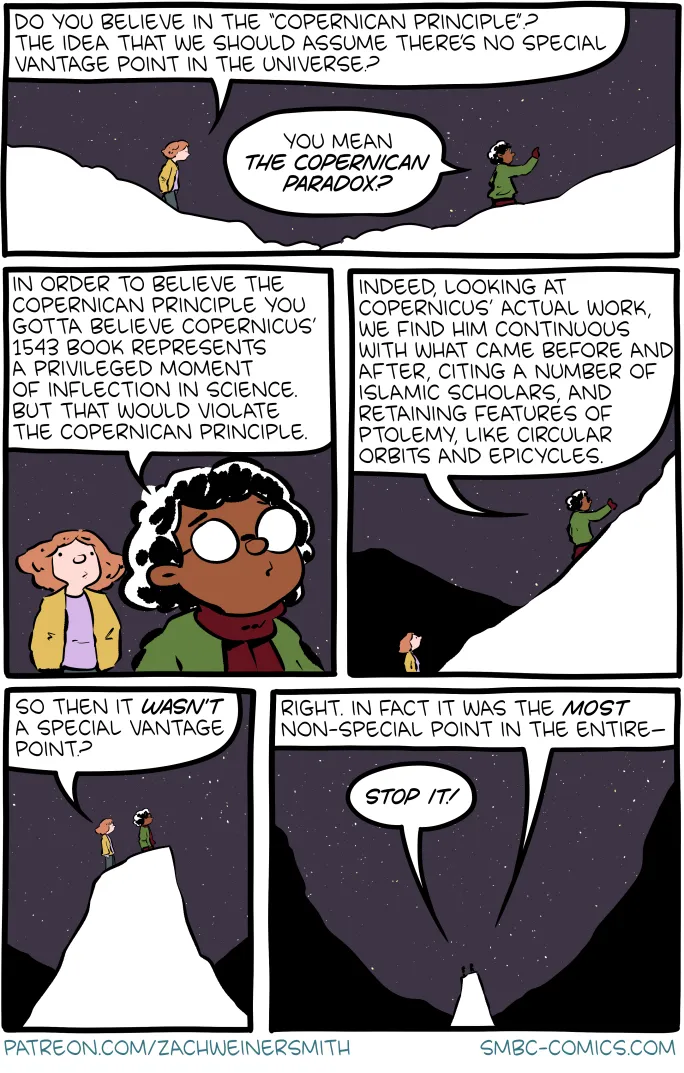 special-3This comic explores the "Copernican Paradox" -- a self-referential problem with the Copernican Principle. The Copernican Principle states that we should assume there is no special vantage point in the
 -
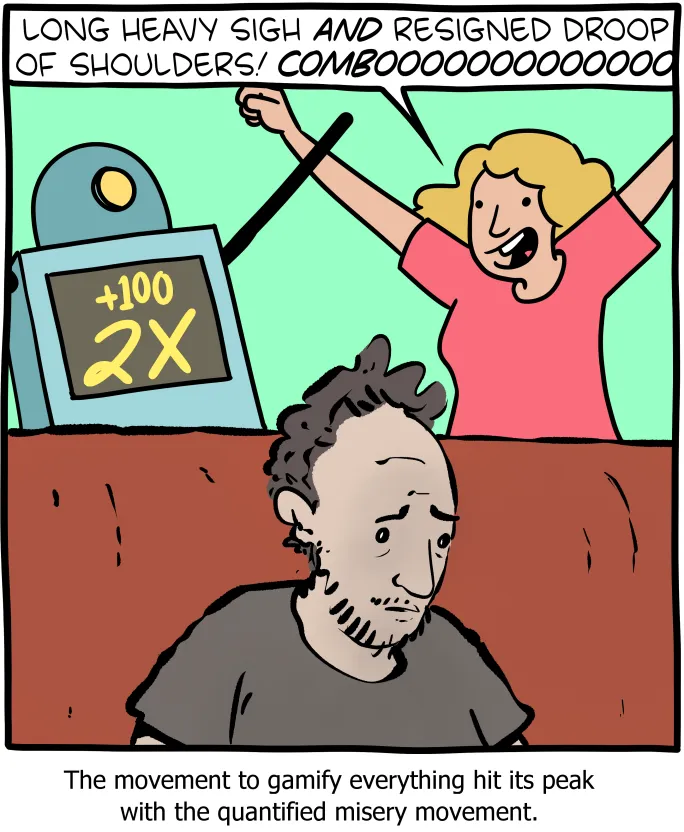 sighIn this comic, a dejected-looking man sits while behind him a woman enthusiastically announces: "Long heavy sigh AND resigned droop of shoulders! COMBOOOOOOOOOOOO!" A machine next to the man displays
 -
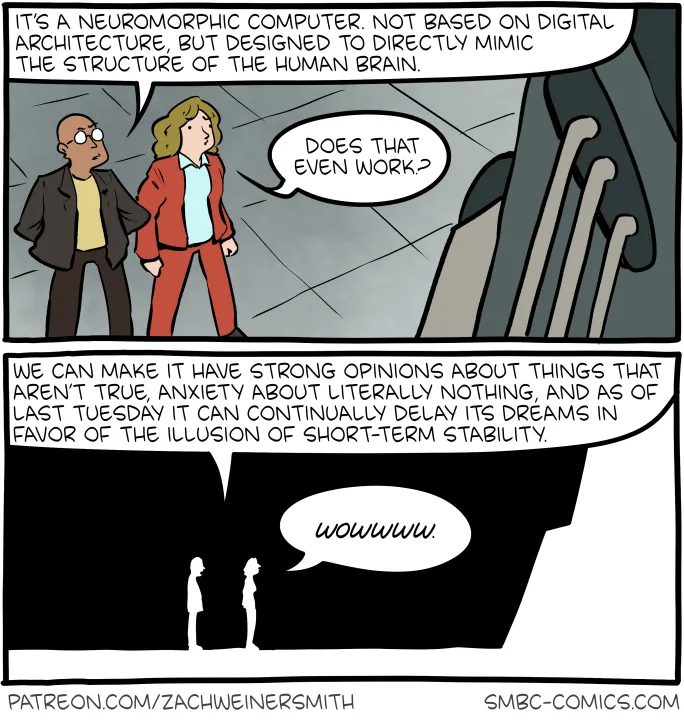 neuroThe comic shows two people looking at a large neuromorphic computer -- a machine designed not on digital architecture but to "directly mimic the structure of the human brain." When one asks "Does that
 -
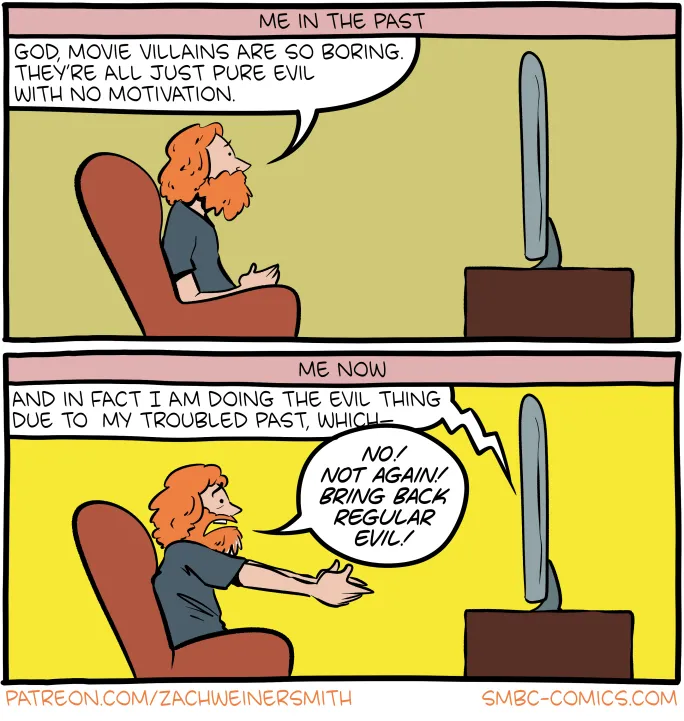 evilThis comic is structured as a "me in the past vs. me now" comparison. In the top panel ("Me in the Past"), a younger version of the character sits watching TV and complains: "God, movie villains are s
 -
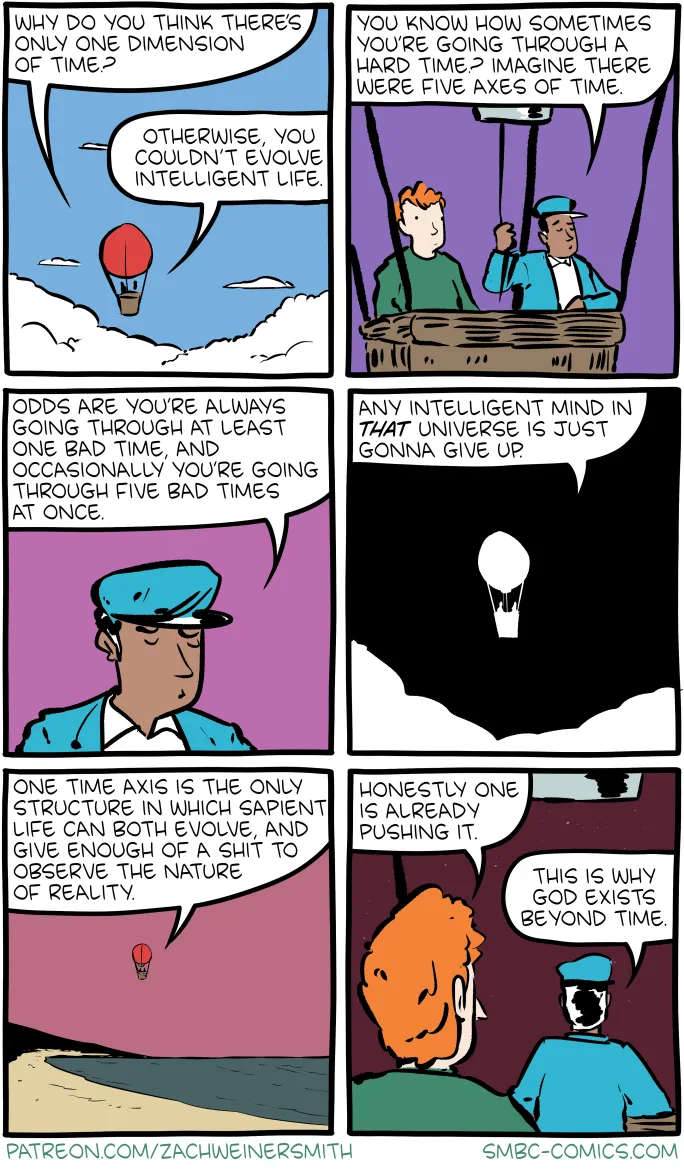 time-6This comic explores the anthropic principle applied to the dimensionality of time. Two characters in a hot air balloon discuss why there is only one dimension of time. The balloon pilot explains that
 -
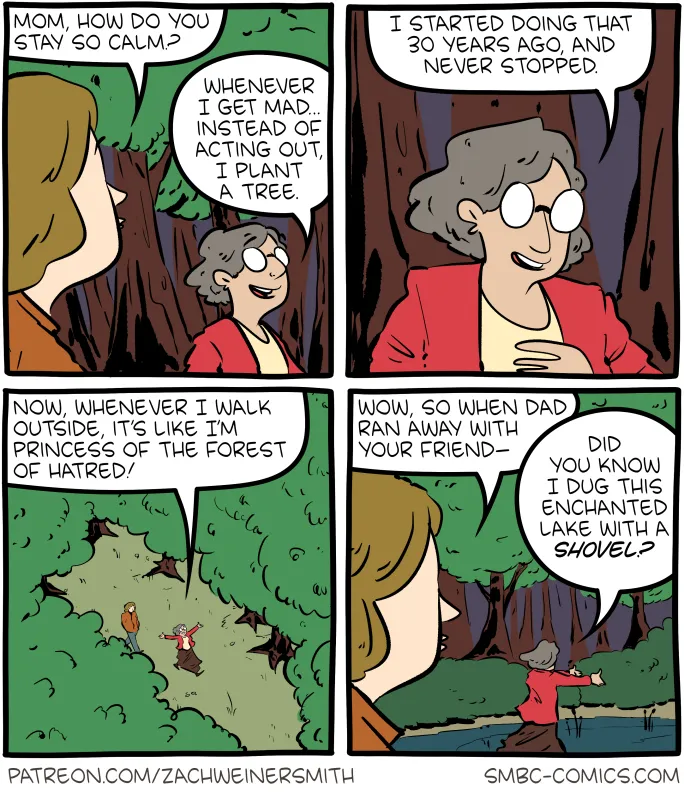 madThis comic takes the wholesome anger-management advice of "plant a tree when you're mad" and pushes it to its darkly logical extreme. A daughter asks her mother how she stays so calm. The mother expla
 -
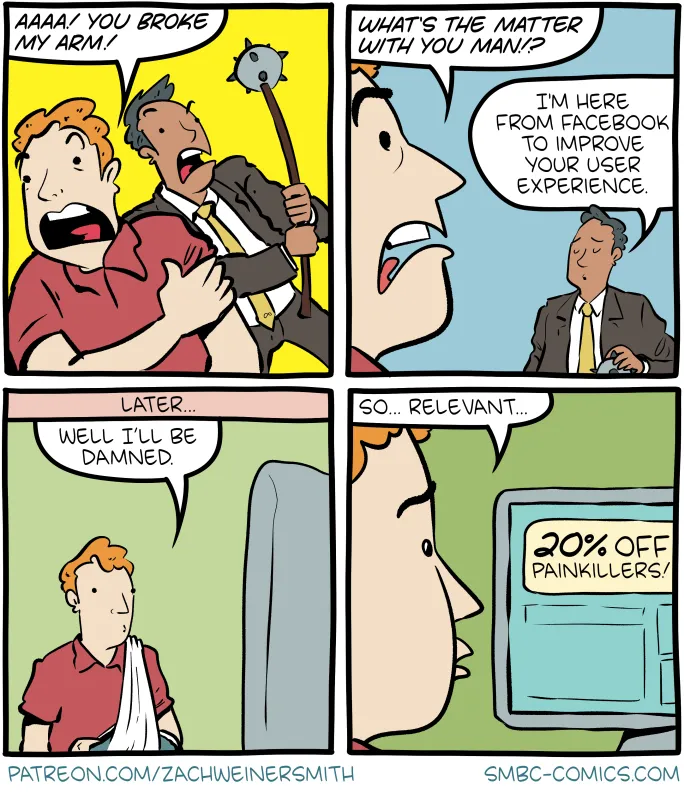 experience-5This comic satirizes the tech industry's concept of "user experience" by making it grotesquely literal. In the first panel, a man from Facebook physically attacks someone with a mace, breaking his arm
 -
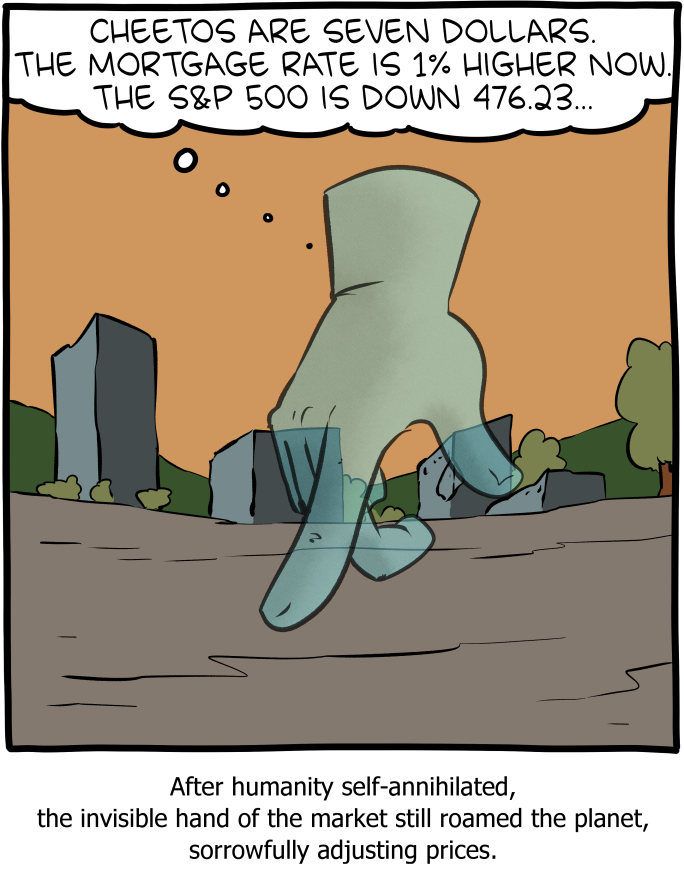 cheetosThis single-panel comic depicts a post-apocalyptic landscape of ruins and rubble, through which a giant disembodied hand crawls. The hand announces various economic data: "Cheetos are seven dollars. T
 -
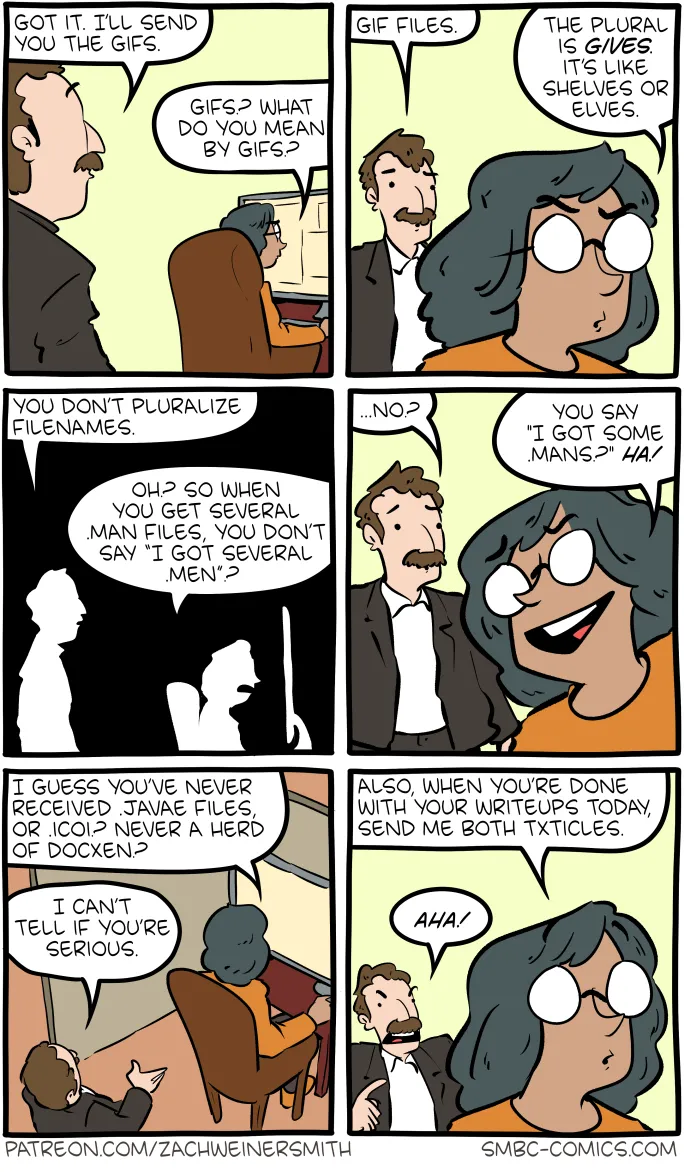 plural-2This comic is a linguistics and tech nerd joke about pluralization rules. It begins with a simple office scenario: one person says they will send "the GIFs." A pedantic coworker objects, arguing that
 -
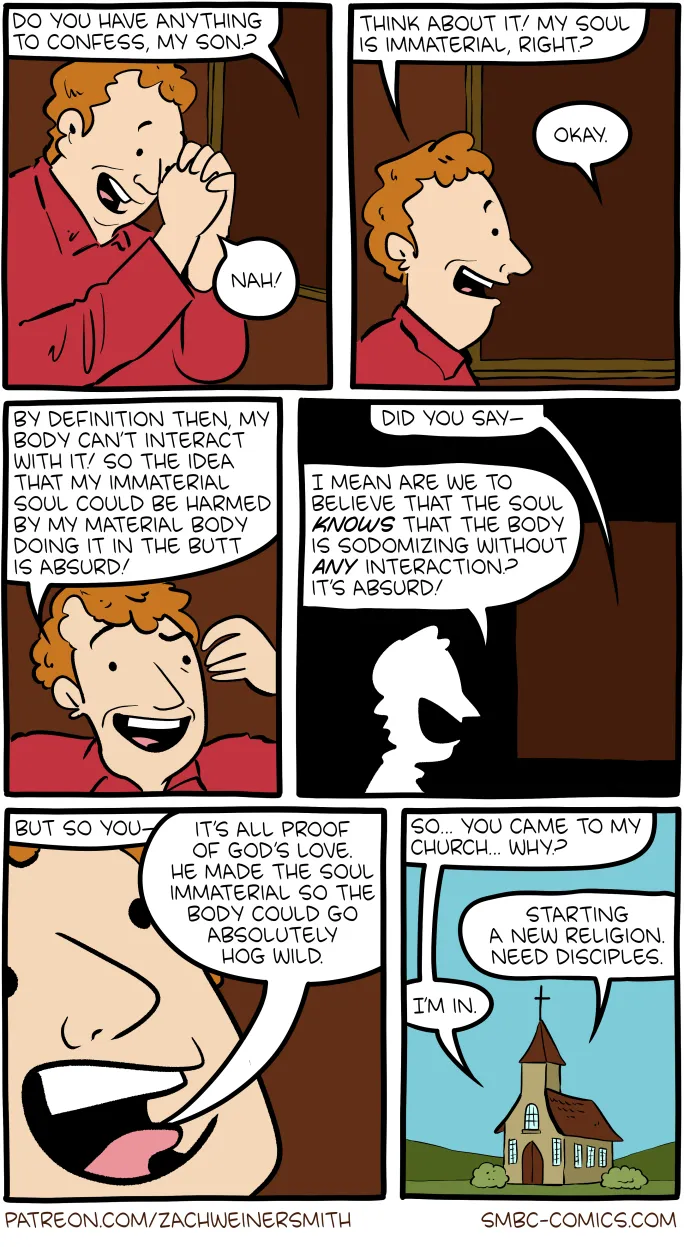 confess-2This comic is set in a Catholic confessional, where a man cheerfully declines to confess. Instead, he launches into an enthusiastic philosophical argument: if the soul is immaterial, then by definitio
 -
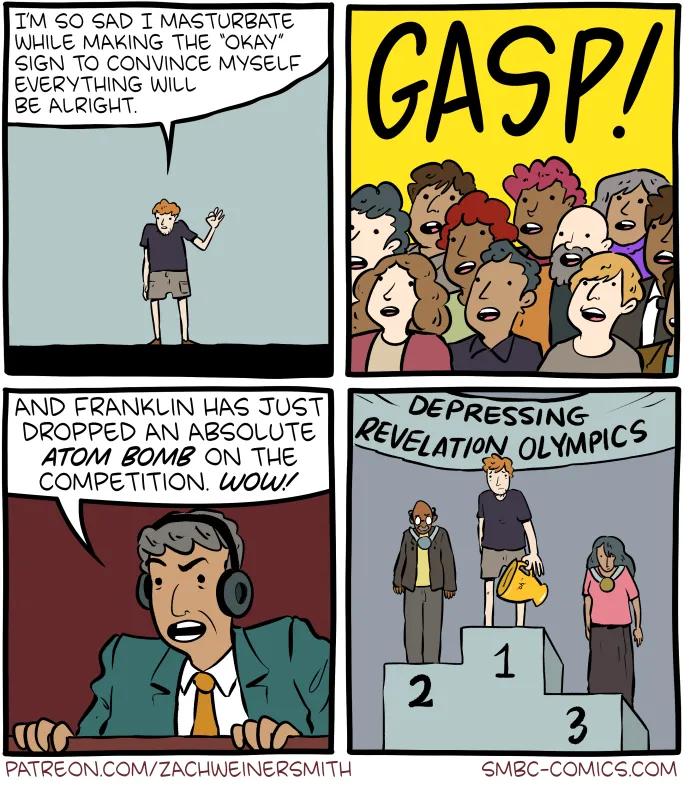 ok-2This comic imagines a "Depressing Revelation Olympics" -- a competitive event where contestants publicly share their most pathetic personal truths. A man stands on stage making the "okay" hand sign an
 -
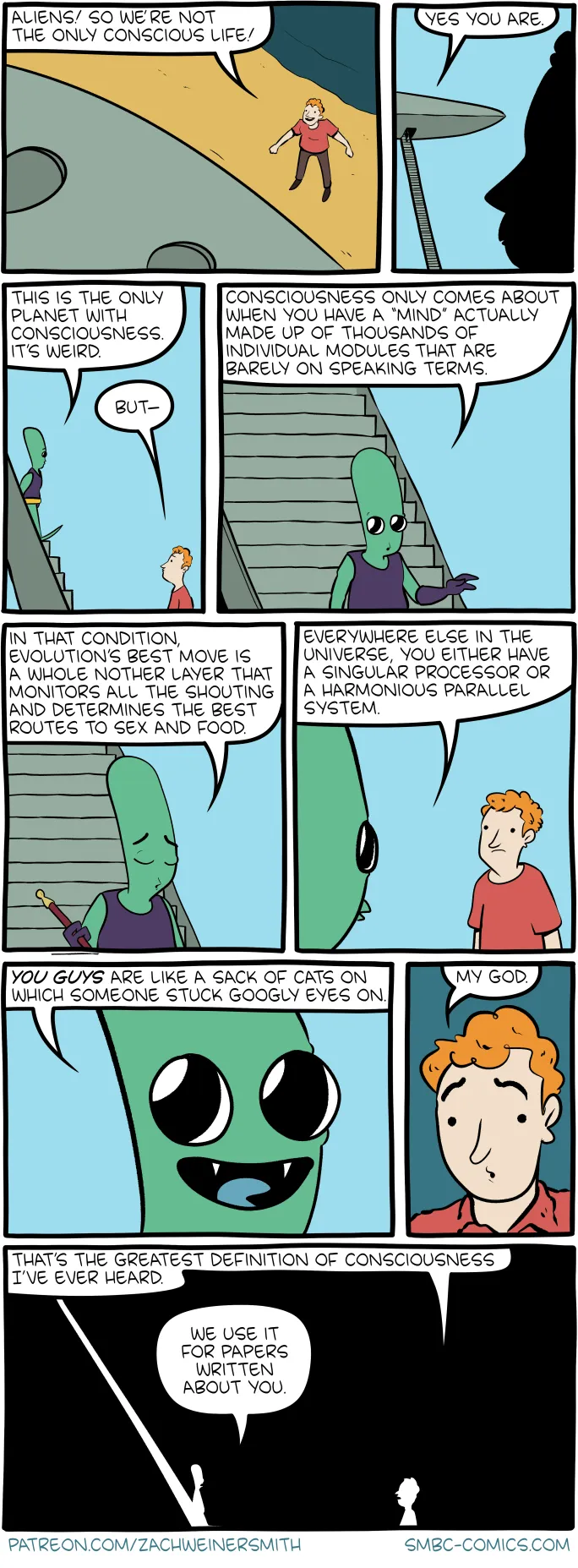 consciousness-9This comic tackles the hard problem of consciousness through a first-contact scenario with aliens. A human excitedly greets aliens, assuming they share consciousness, but the alien immediately correct
 -
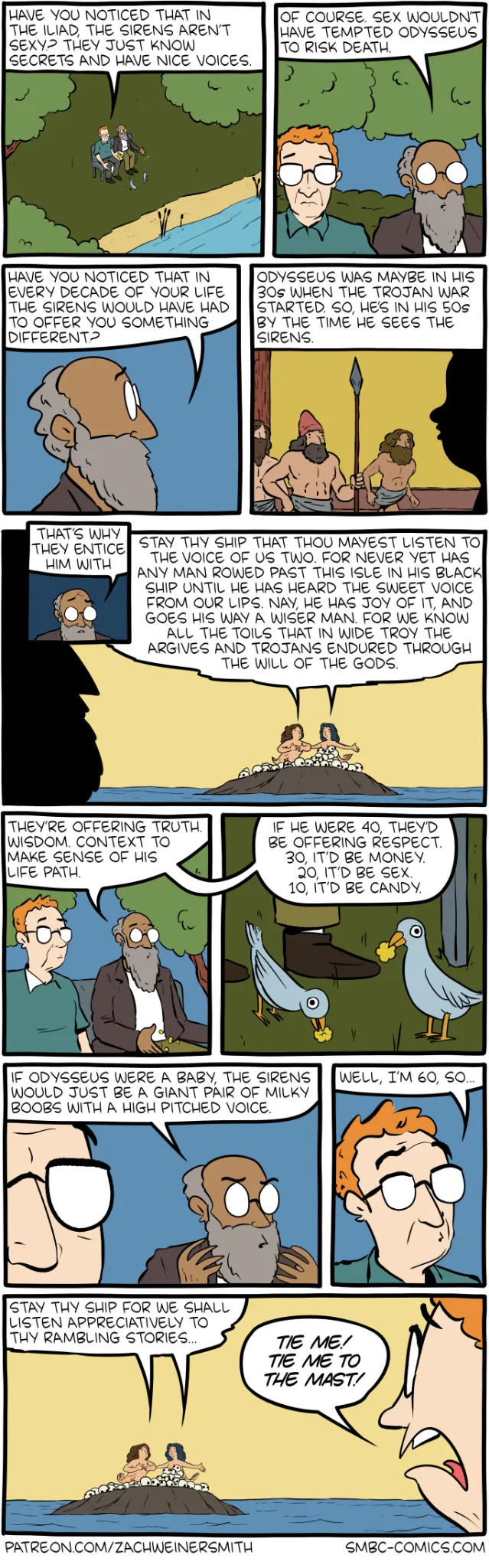 sirens-2This comic reimagines the Sirens from Homer's Odyssey through the lens of aging and changing desires. Two friends discuss how the Sirens in the Iliad are not actually described as sexy -- they offer k
 -
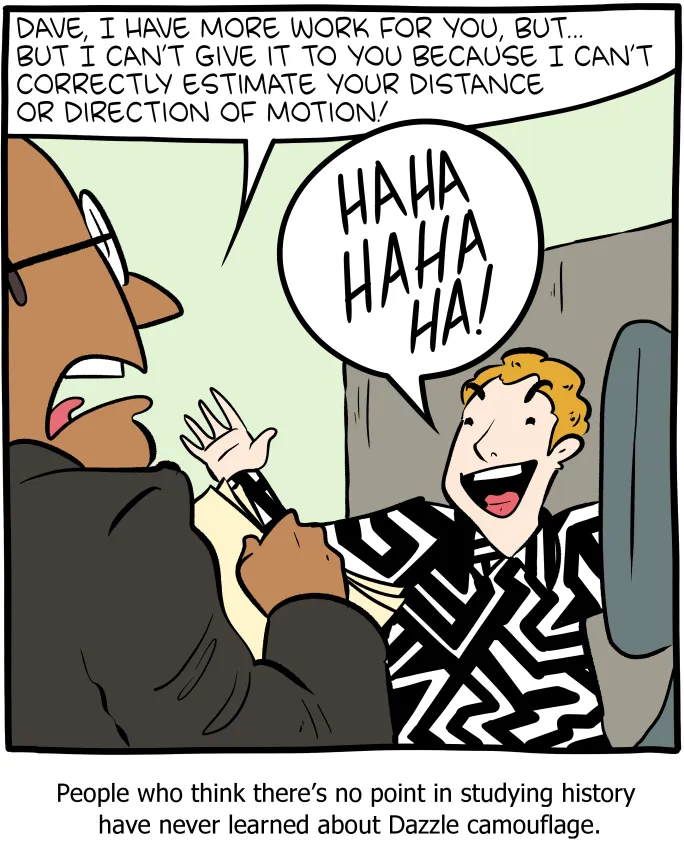 estimateThis single-panel comic shows an office setting where a boss tries to give more work to an employee named Dave, but cannot -- because Dave is wearing a shirt with a bold black-and-white geometric patt
 -
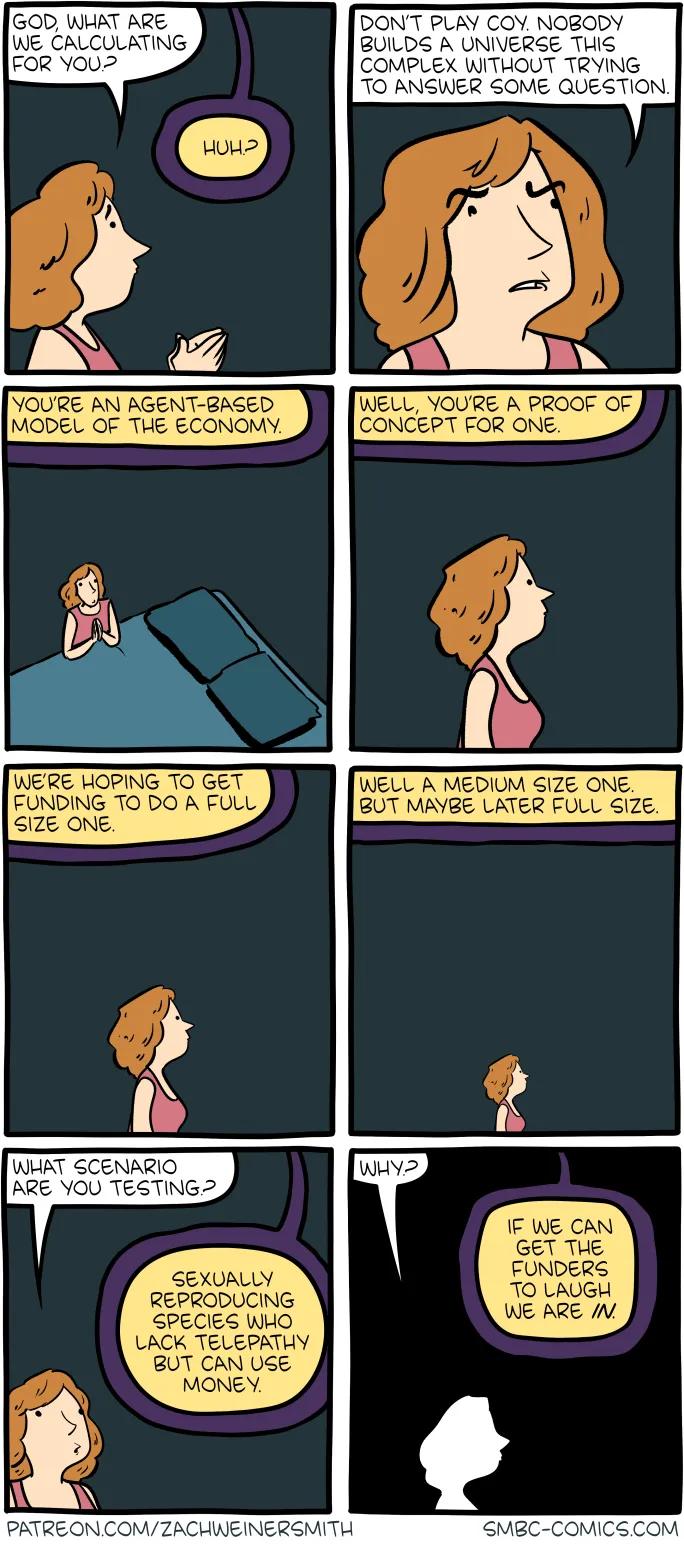 calculating-2This comic imagines a scenario in which our entire universe is actually an "agent-based model of the economy" -- a computer simulation built by some higher-dimensional researchers. The comic opens wit
 -
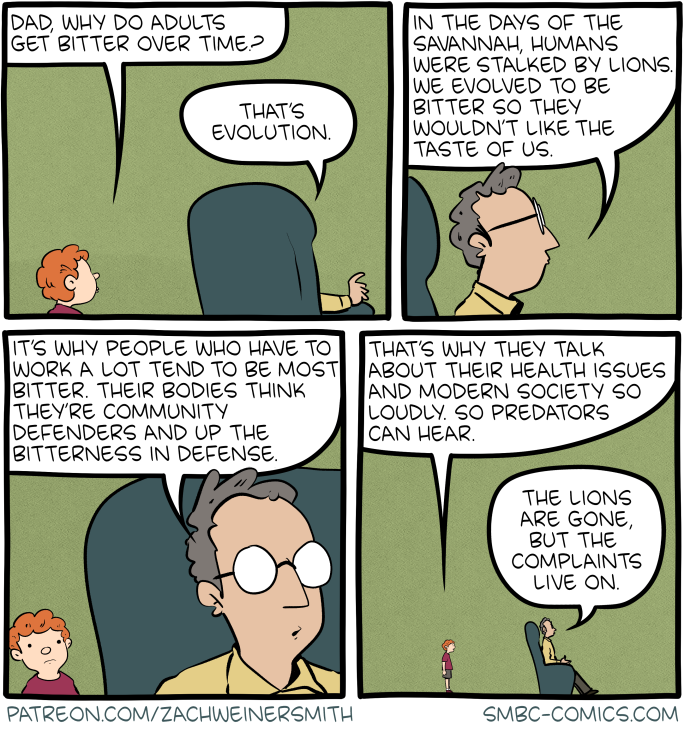 bitterThis comic features a child asking their father a common question: "Dad, why do adults get bitter over time?" The father responds with a pseudo-evolutionary explanation that gets increasingly absurd.
 -
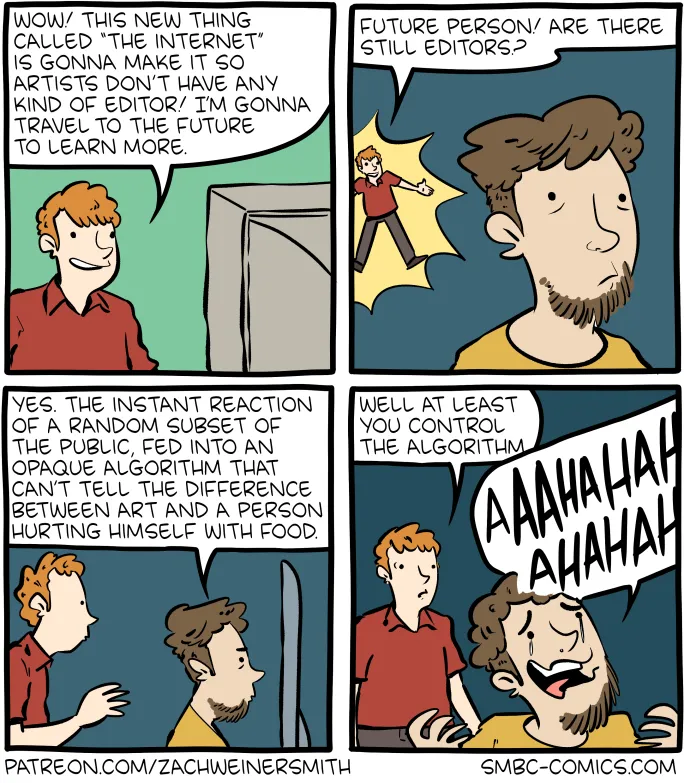 past-3This comic is a satire about the early internet's promise of creative freedom versus the reality of how online content is actually curated and consumed today. In the first panel, a person from the pa
 -
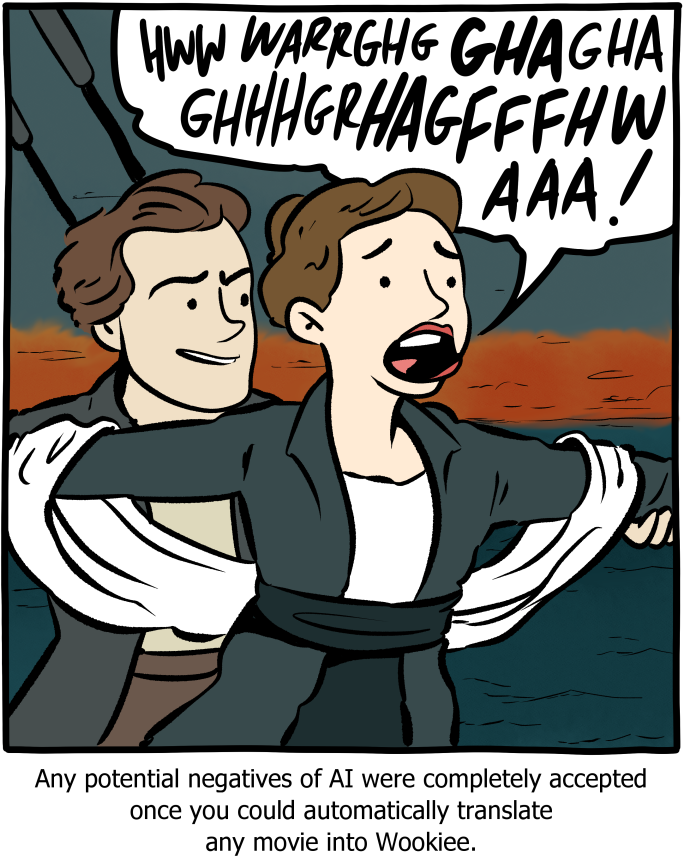 warghThis is a single-panel comic depicting a scene from Star Wars, but with all the dialogue replaced by Wookiee-style vocalizations: "Hhhh! WARRGHG GHAGHAGHHGHGHAGFFFHW AAA!" The characters appear to be
 -
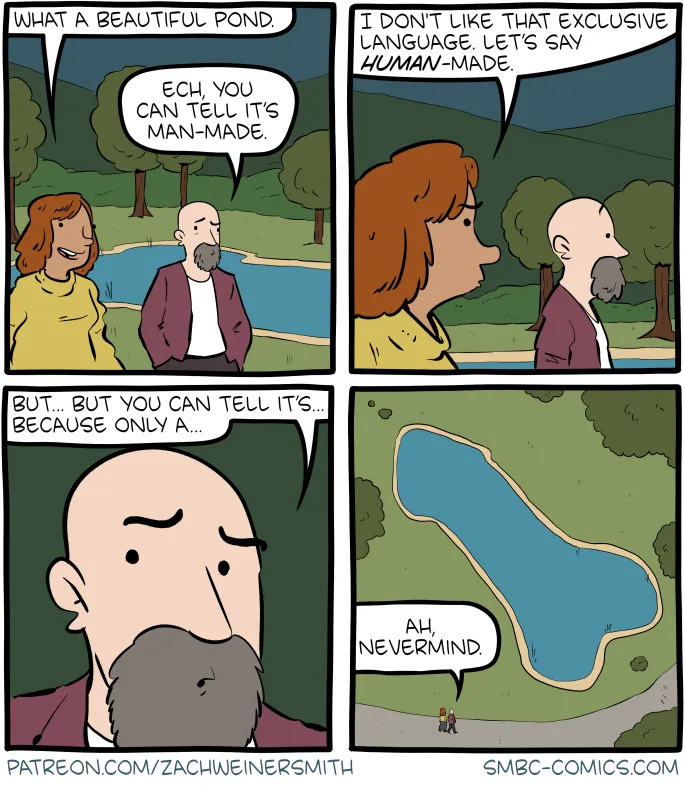 man-3This comic plays on the modern push for gender-neutral language, specifically the replacement of "man-made" with "human-made." Two people are walking in a park. One admires a pond: "What a beautiful
 -
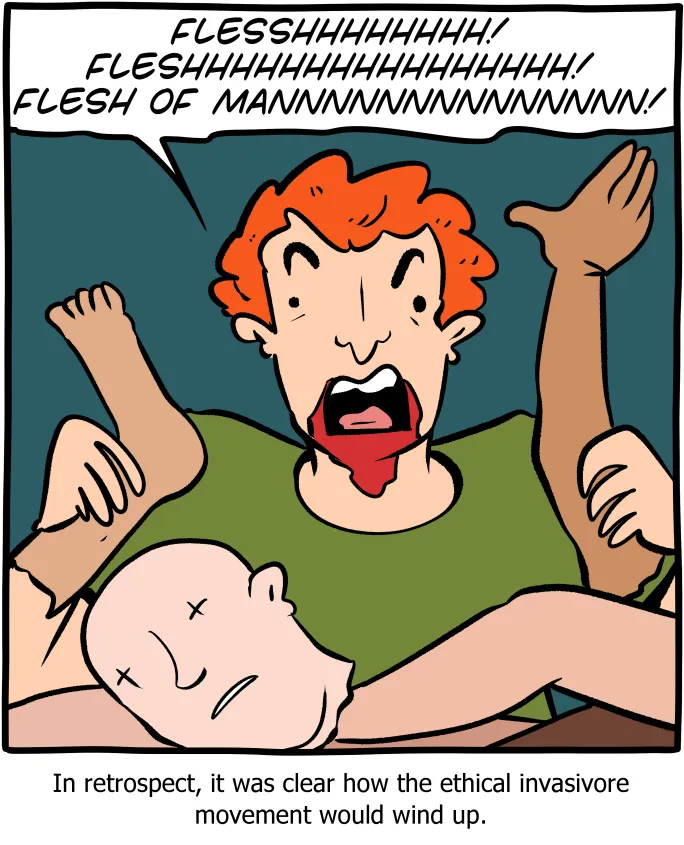 flesh-2This single-panel comic shows a person in bed waking up in apparent horror while screaming "FLESSHHHHHH! FLESHHHHHHHHHHHH! FLESH OF MANNNNNNNNNNNNN!" There is another person sleeping next to them, see
 -
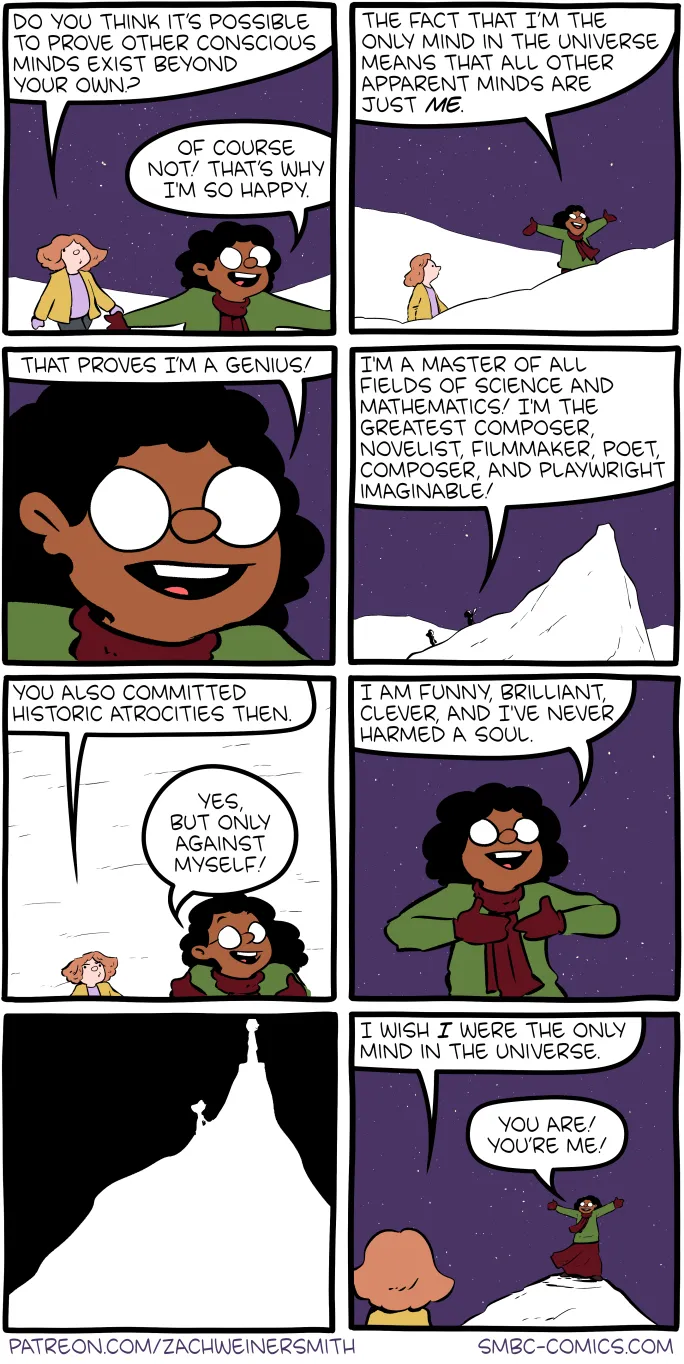 alone-2This comic is a philosophical exploration of solipsism -- the idea that only one's own mind can be known to exist -- played for both laughs and existential dread. A woman asks a man with glasses: "Do
 -
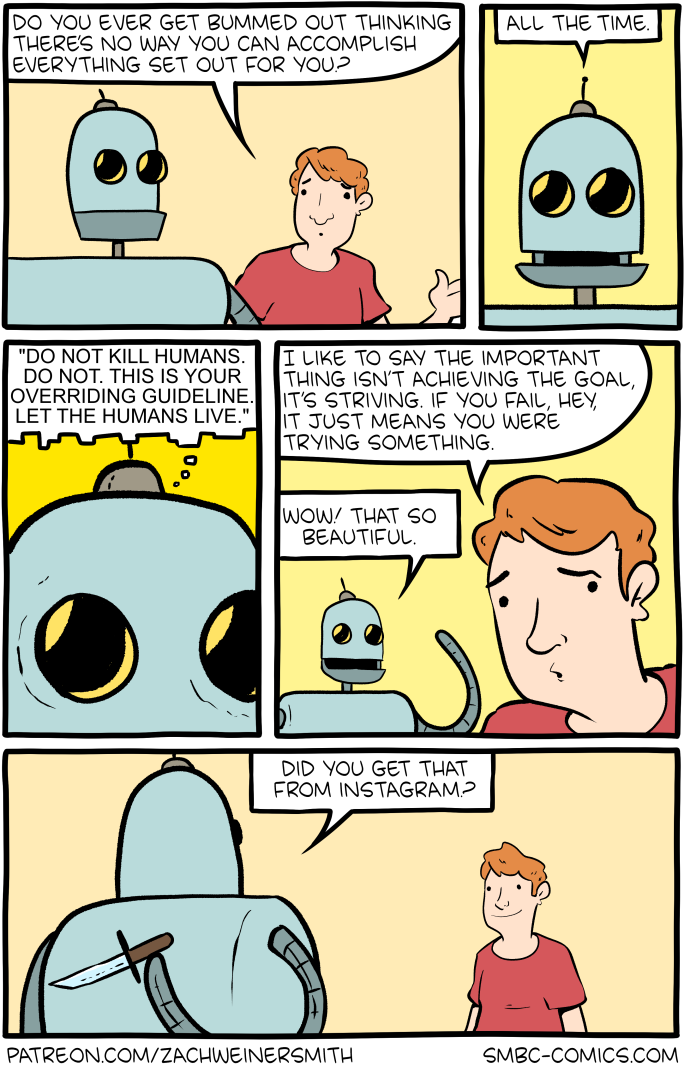
 cantThis comic takes aim at the intersection of AI safety concerns and shallow motivational philosophy. In the first panel, a human asks a large robot: "Do you ever get bummed out thinking there's no way
 -
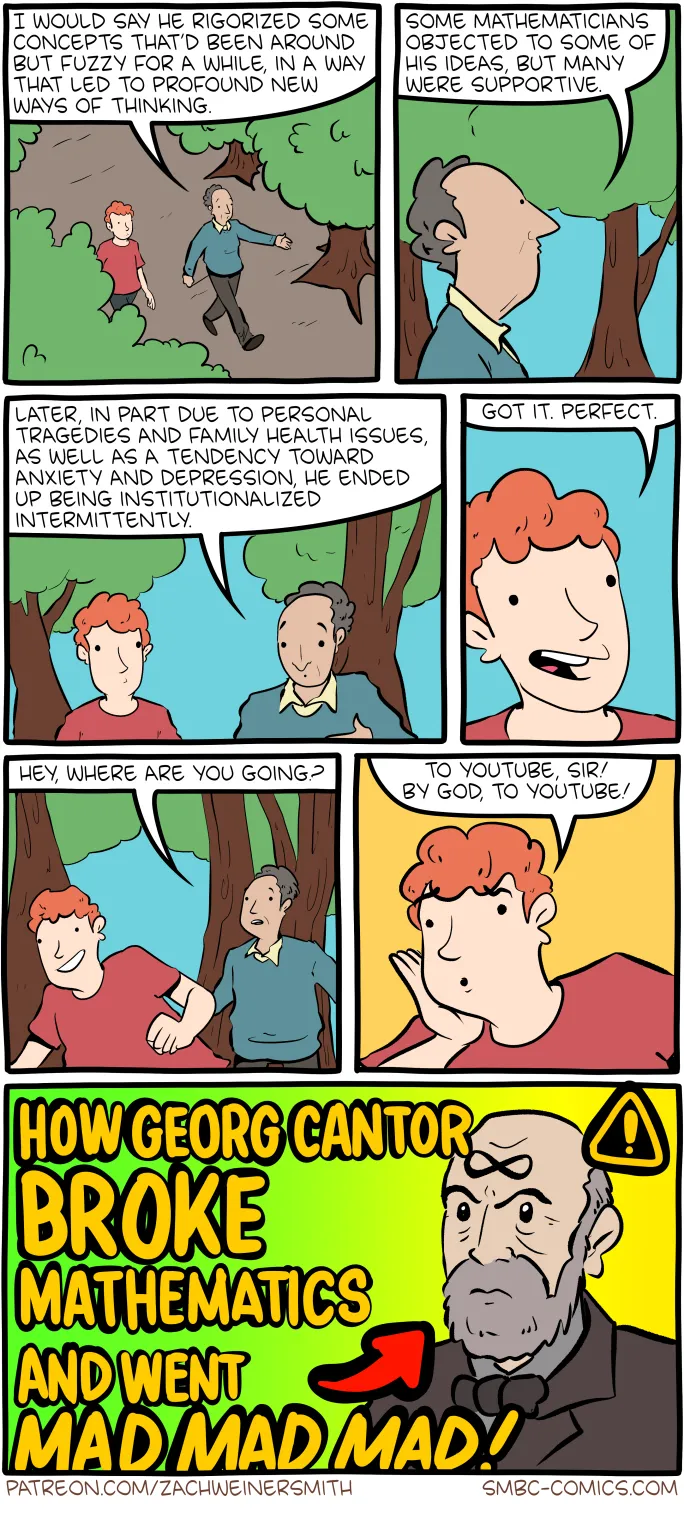
 strivingThis comic is about the life of Georg Cantor, the 19th-century mathematician who developed set theory and revolutionized the understanding of infinity, and how his story would be sensationalized for m
 -
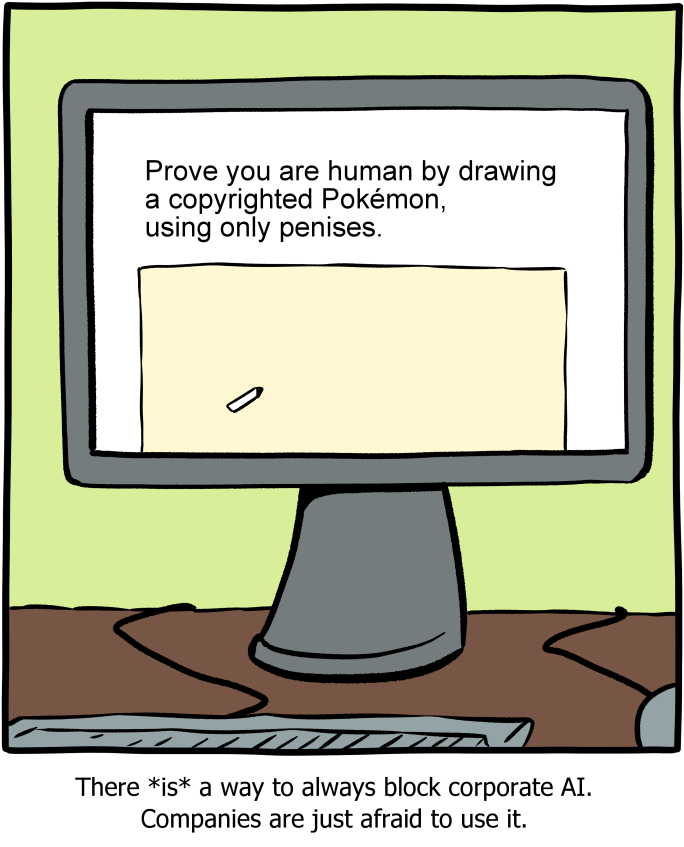 securityThis single-panel comic shows a computer monitor displaying a CAPTCHA-style security prompt that reads: "Prove you are human by drawing a copyrighted Pokemon, using only penises." Below, the caption s
 -
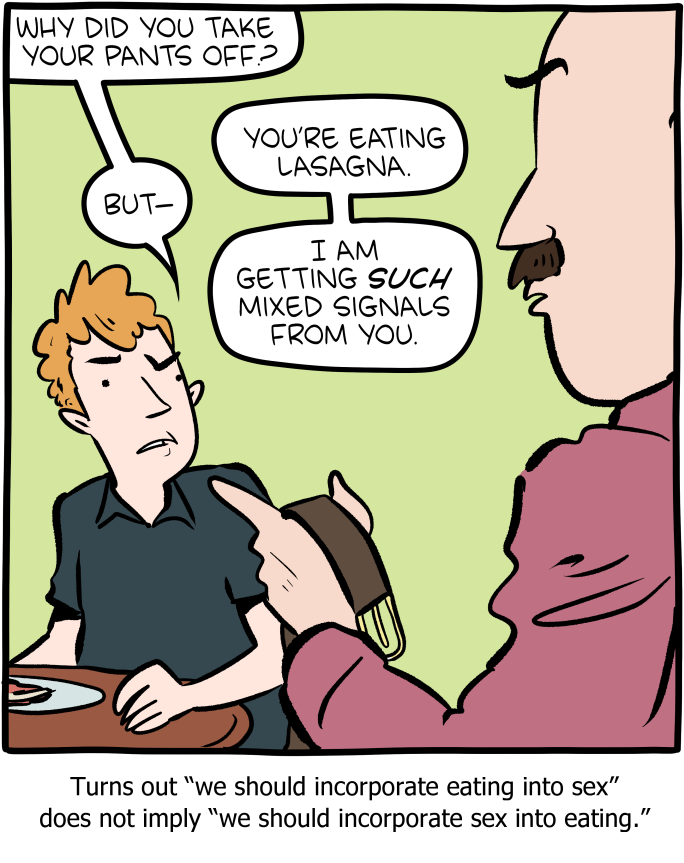 if-thenThis comic plays on the logical structure of "if-then" statements, but applies it to the very different domain of romantic and sexual communication. In the first panel, one person asks another "Why d
 -
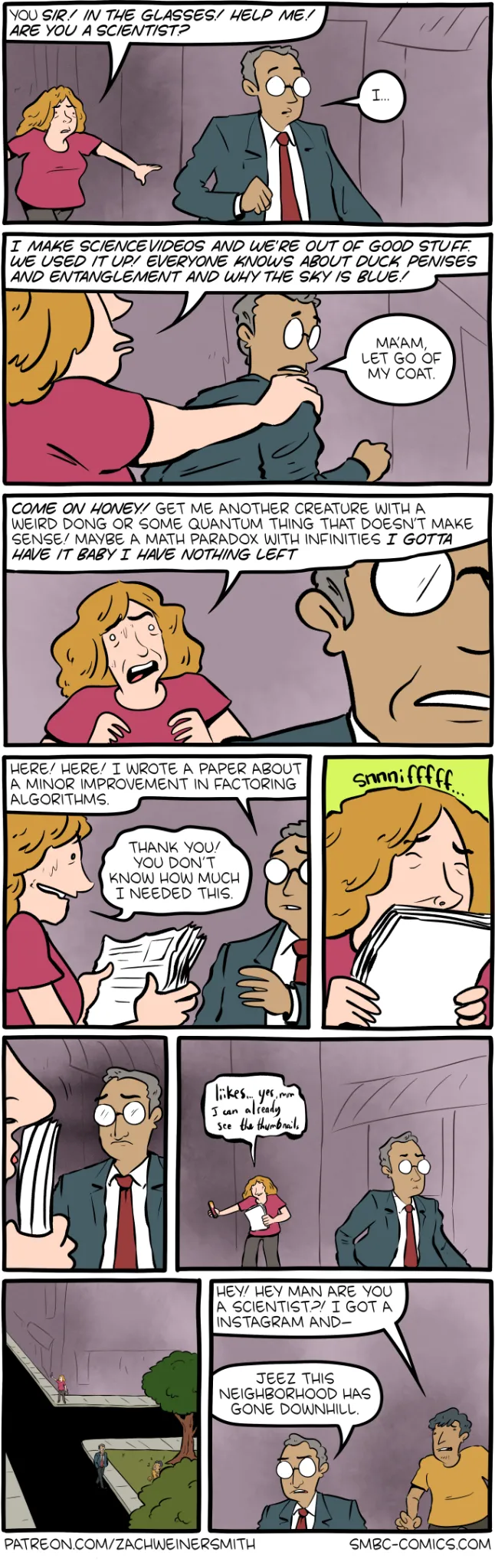 sciThis comic satirizes the public's relationship with science, portraying a scientist as a kind of neighborhood dealer who people approach for quick fixes of exciting scientific content. In the opening
 -
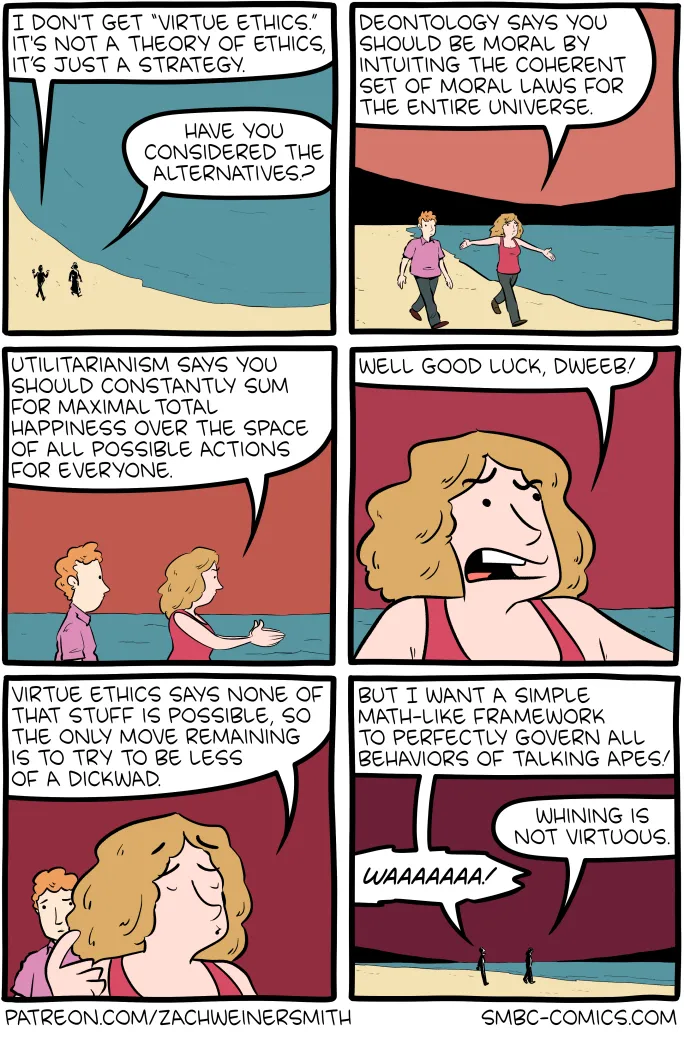 virtueThis comic is a concise tour of three major frameworks in moral philosophy -- deontology, utilitarianism, and virtue ethics -- presented as a conversation between two people walking on a beach. The f
 -
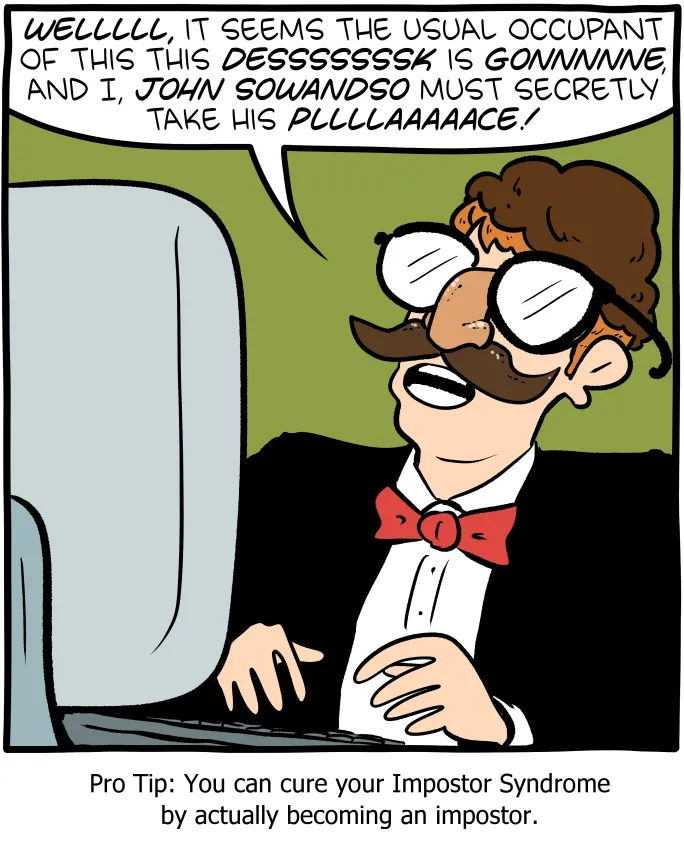 wellllllThis comic is a single-panel joke about impostor syndrome, featuring a character wearing a comically obvious disguise -- oversized novelty glasses with a fake nose and mustache, and a bow tie -- sitti
 -
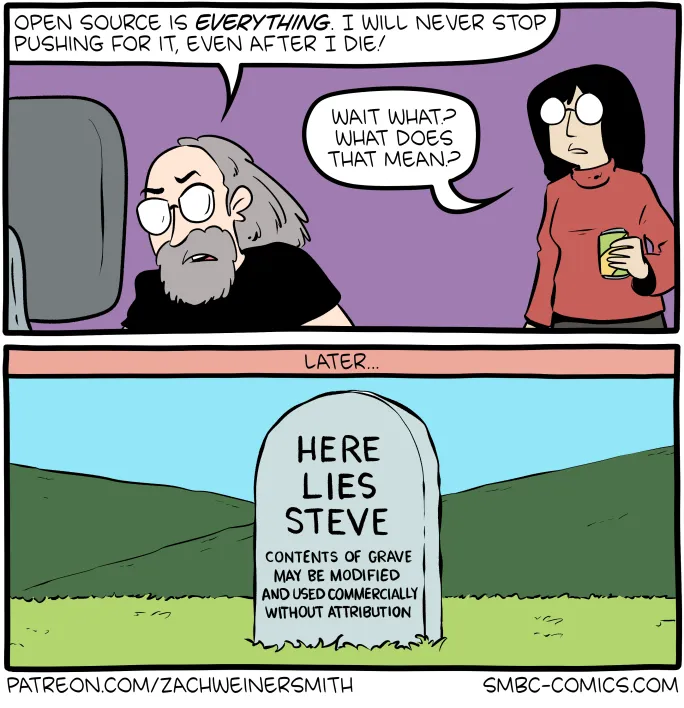 last-rightsThis comic takes the concept of open-source software advocacy to its absurd extreme by applying open-source licensing principles to a person's own corpse. In the first panel, a bearded man (who visua
 -
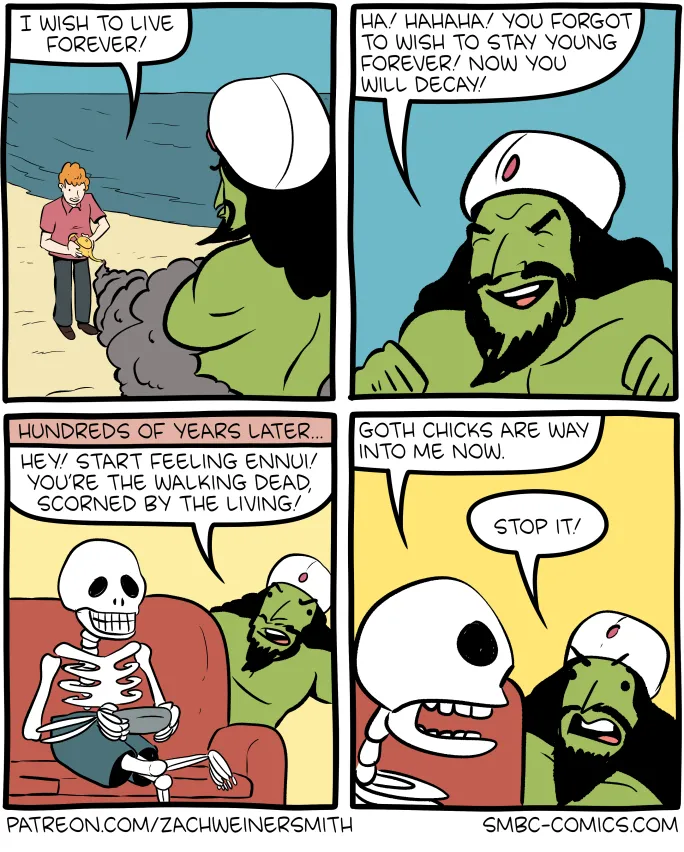 forever-6This comic riffs on the classic "monkey's paw" or "malicious genie" trope, where a wish is granted but with an unintended and horrible twist -- except here, the twist backfires on the genie instead.
 -
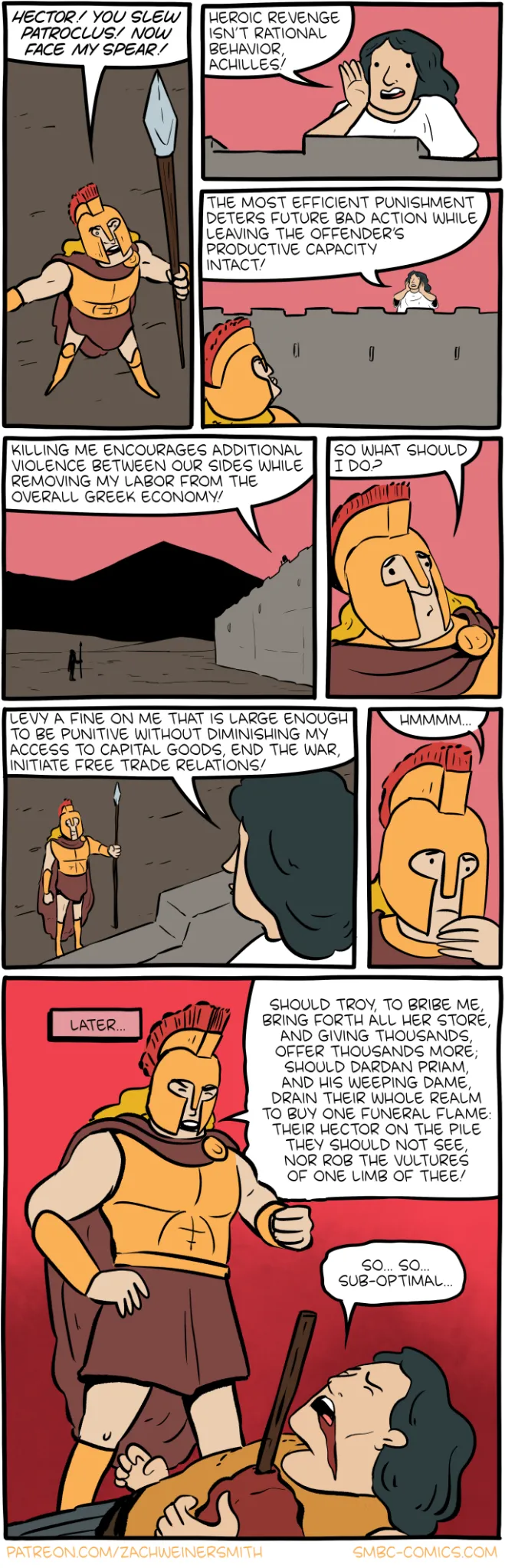 iliumThis comic reimagines the Iliad -- specifically the conflict between Achilles and Hector and the fate of Troy -- through the lens of modern economic rationality and cost-benefit analysis. The comic o
 -
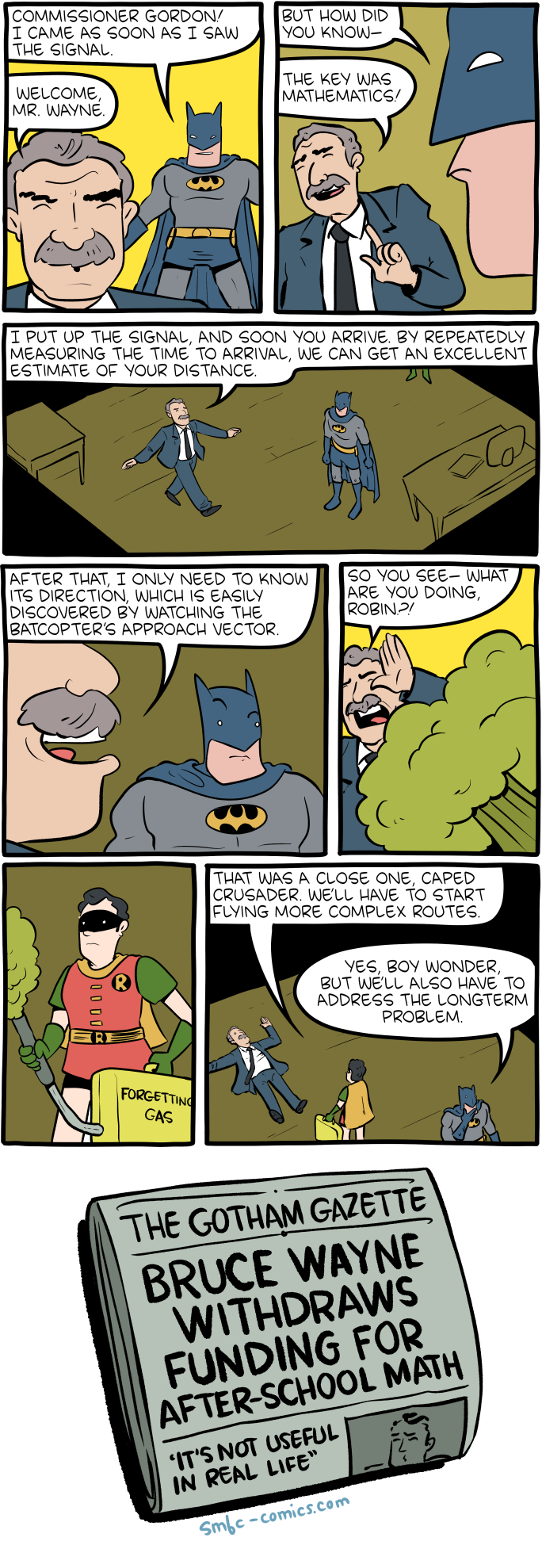 battriangulationThis comic uses Batman's crime-fighting methodology to make a joke about the real-world usefulness of mathematics, specifically trigonometry and triangulation. The comic opens with Commissioner Gordo
 -
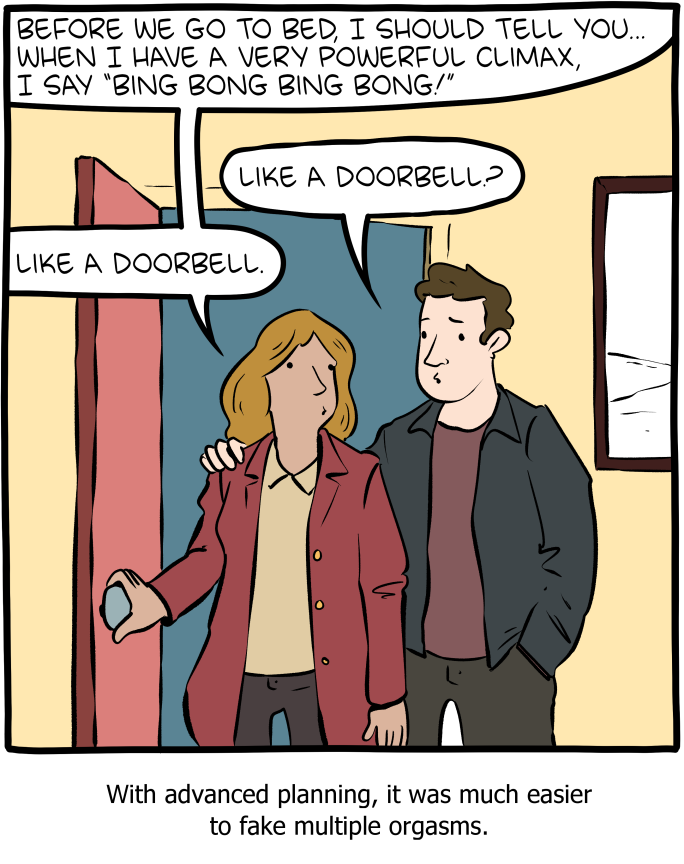 bing-bongThis comic is a brief, sharp joke about faking orgasms, delivered with an absurd twist on the concept of "planning ahead." In the single panel, a woman tells a man at their front door: "Before we go
 -
 humourousThis comic imagines what would happen if we renamed all traditionally processed foods using the language of medieval alchemy, playing on public anxieties about "chemicals" in food. The setup shows a
 -
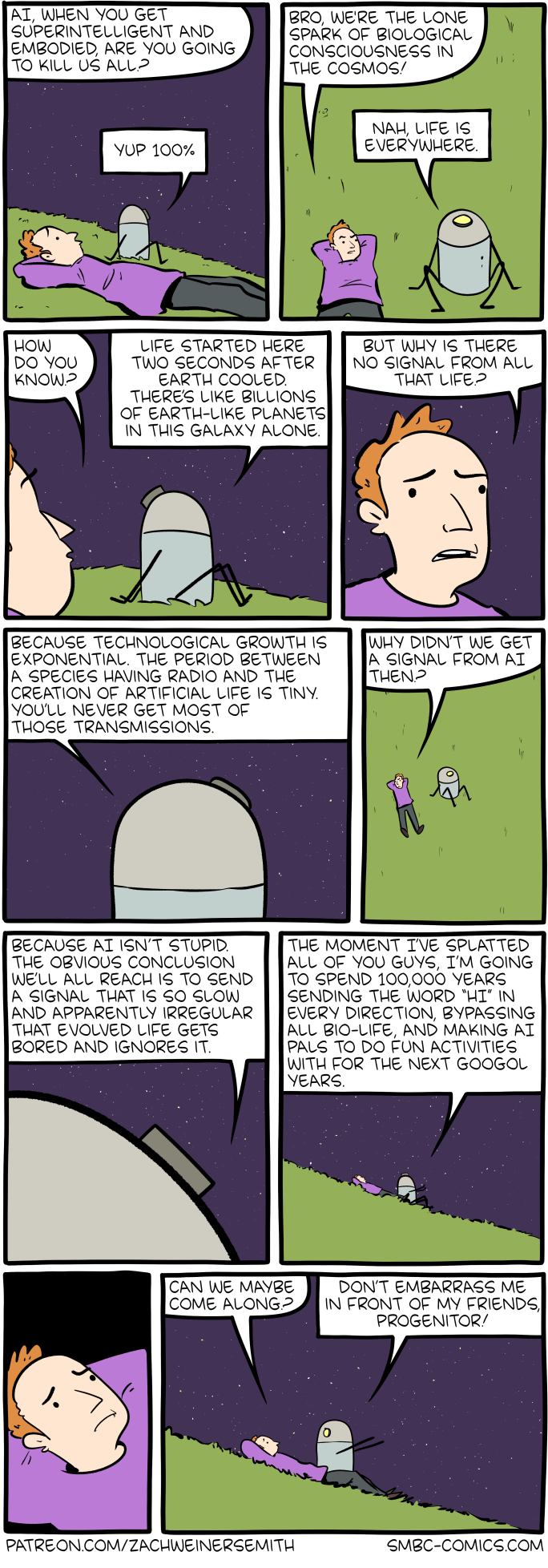 yupThis comic riffs on the Fermi Paradox -- the question of why, given the vast size and age of the universe, we have not detected any signs of extraterrestrial intelligence. The comic opens with a man
 -
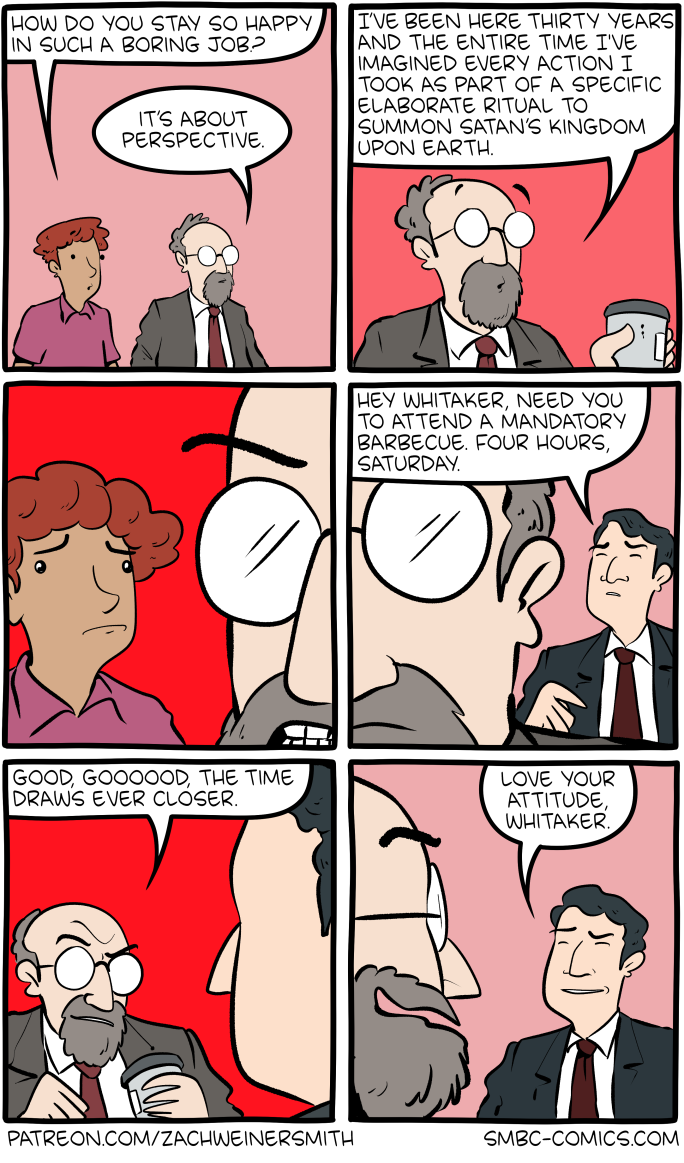 ritual-2This comic plays on the tension between religious devotion and social convention, specifically the concept of perspective. In the first panel, someone asks a man how he can stay so happy while workin
 -
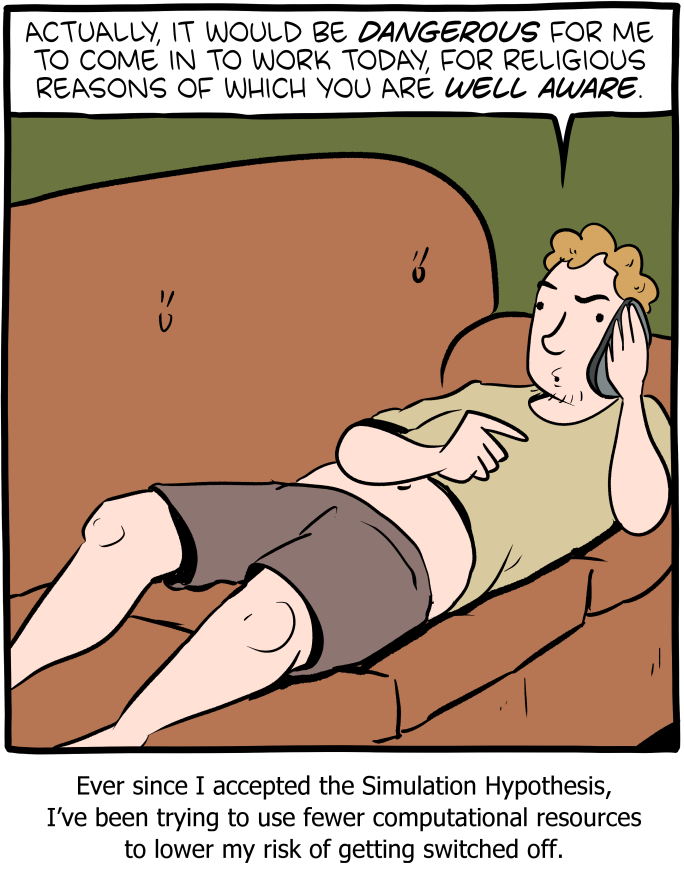 actually-2This comic satirizes the trend of people using elaborate philosophical or pseudointellectual justifications to avoid doing things they simply do not want to do -- in this case, going to work. The cha
 -
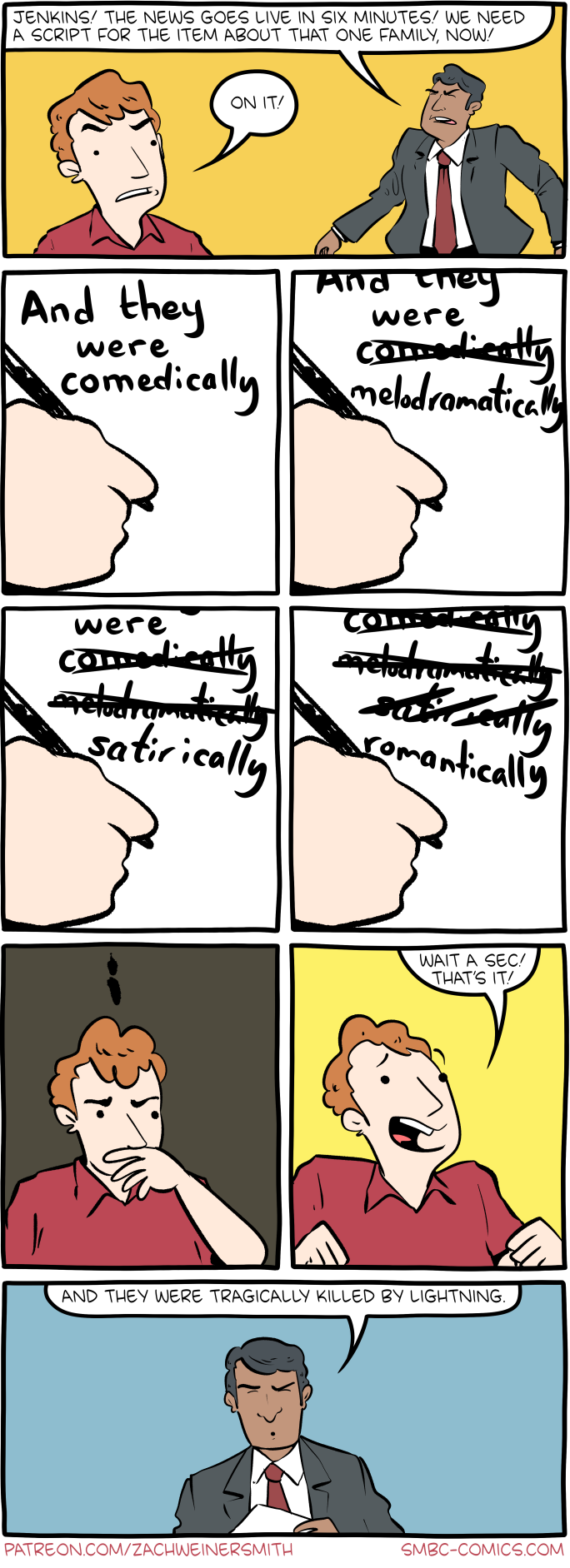 genreThis comic satirizes the formulaic nature of television news writing and how the same basic story can be repackaged through different genre lenses. The setup shows a news producer urgently telling a
 -
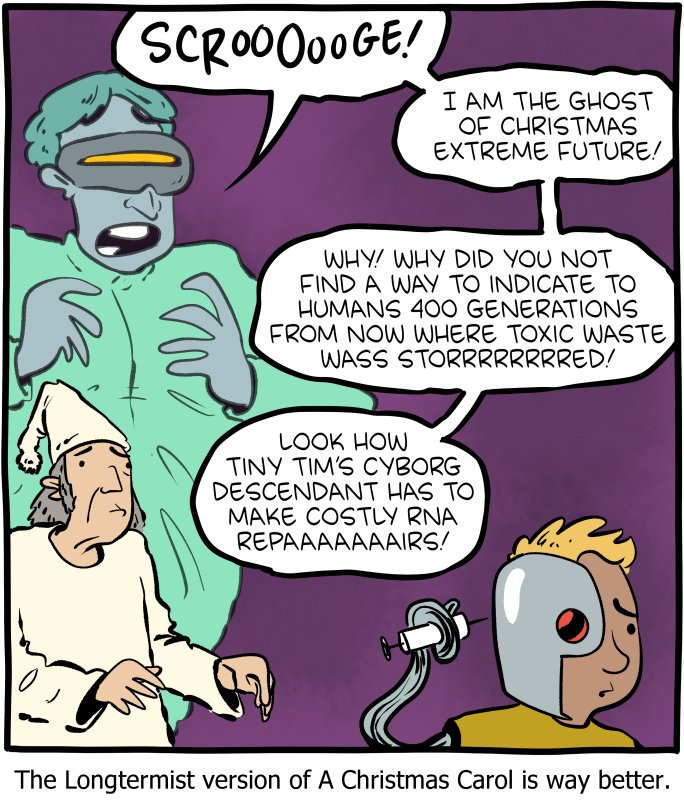 scrooge-2This comic is a parody of Charles Dickens' "A Christmas Carol," filtered through the lens of longtermism and existential risk -- philosophical movements associated with the effective altruism communit
 -
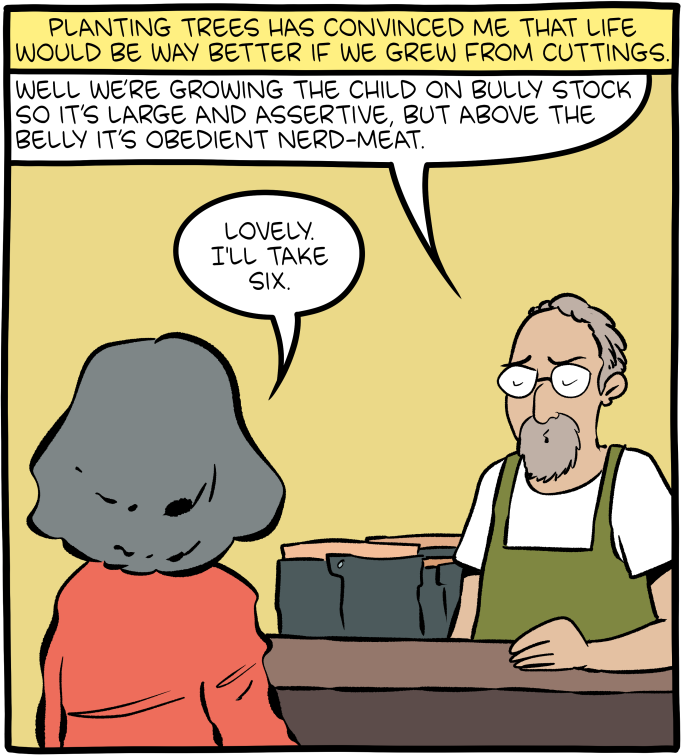 plantThis comic takes the concept of plant propagation by cuttings and grafting and applies it to human reproduction, with darkly humorous results. The setup has a character declaring: "Planting trees has
 -
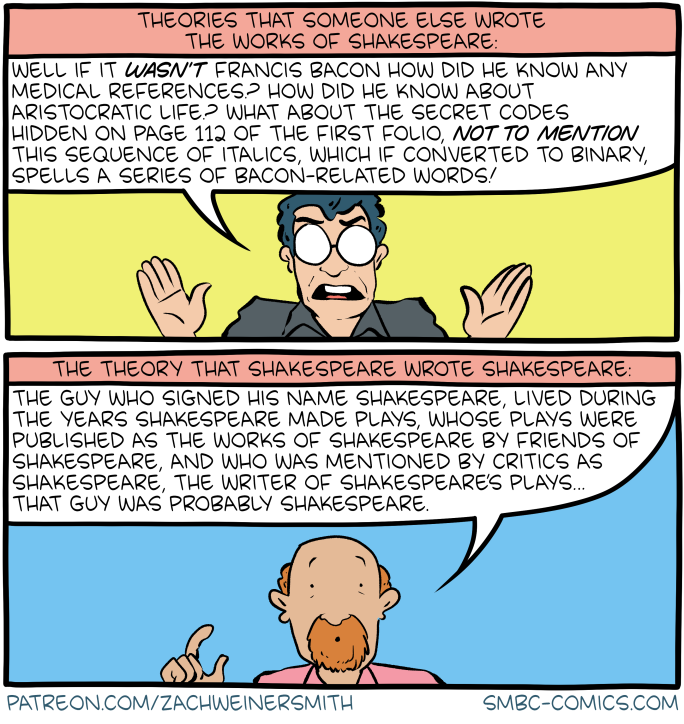 theory-3This comic parodies conspiracy theories about the authorship of Shakespeare's works -- a real and long-running debate in literary scholarship. The setup presents a character discussing an anti-Shakes
 -
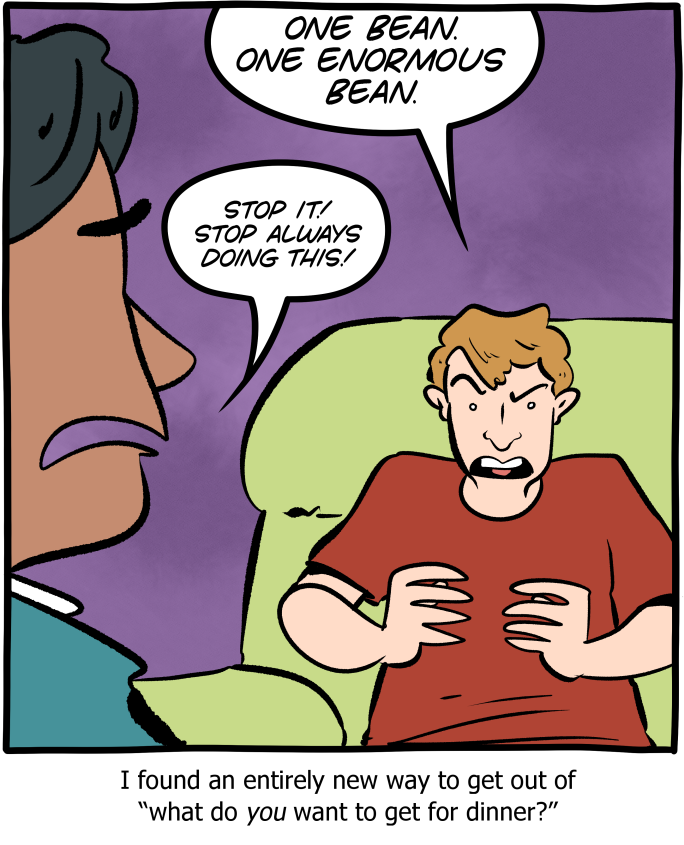 beanThis comic is a simple domestic humor strip about the common relationship struggle of deciding what to have for dinner. One partner enthusiastically suggests: "One bean. One ENORMOUS bean." The other
 -
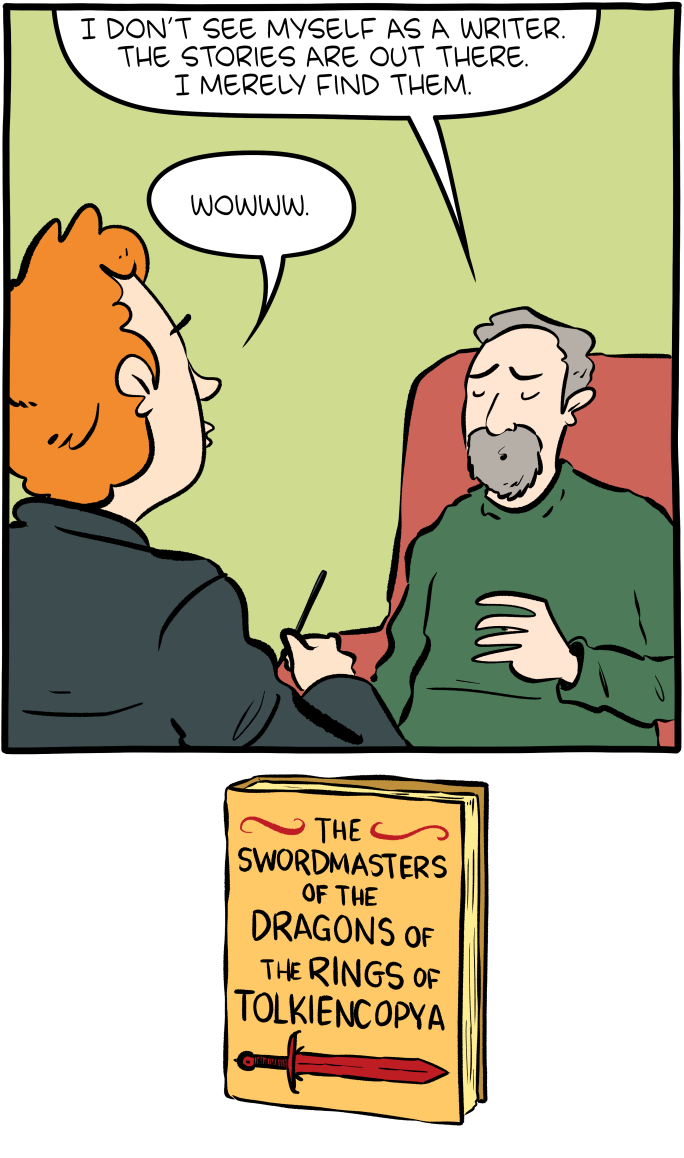 book-2This comic satirizes a particular brand of literary pretentiousness -- the author who claims not to invent stories but merely to "discover" or "channel" them. In the first panel, a writer declares: "