life-9

Explanation
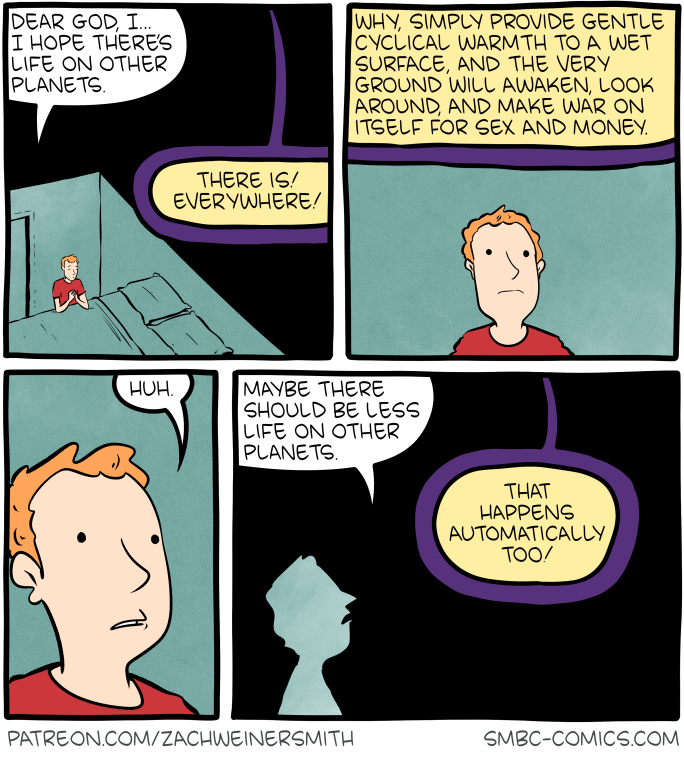
In this comic, a man prays: "Dear God, I know there's life on other planets. Why isn't it everywhere?" He is referencing the Fermi Paradox. God appears and gives a surprisingly candid, cynical answer: that shortly after evolving general intelligence, every civilization invents something akin to a "net" (i.e., the internet) and an "academy" (i.e., academia/research institutions), which then proceeds to consume itself for "geek money" -- presumably grant money, ad revenue, or similar incentives that divert intellectual energy from productive exploration into self-referential, insular pursuits.
In the next panel, the man is disturbed and says: "There's no life... EVERYWHERE?" Another person comments: "Maybe there would be less life on other planets too." The man then realizes: "That happens automatically too!" -- suggesting that the same self-destructive pattern is universal.
The comic offers a satirical explanation for the Fermi Paradox -- the apparent contradiction between the high probability of extraterrestrial civilizations and the lack of evidence for them. The traditional answers to the Fermi Paradox include nuclear self-destruction, resource depletion, or the "Great Filter" hypothesis. This comic proposes a more mundane and contemporary Great Filter: that all intelligent civilizations eventually invent the internet and academia, which then absorb all their intellectual energy into pointless internal competitions for status and funding, preventing them from ever becoming a spacefaring civilization.
This is a characteristically SMBC take, as the comic's author Zach Weinersmith is well-versed in both academic culture and internet culture, and frequently satirizes both. The joke resonates with concerns about how much human intellectual capital is devoted to social media engagement, academic publish-or-perish culture, and other systems that reward activity without necessarily producing meaningful progress.