scrooging
Explanation
The Joke
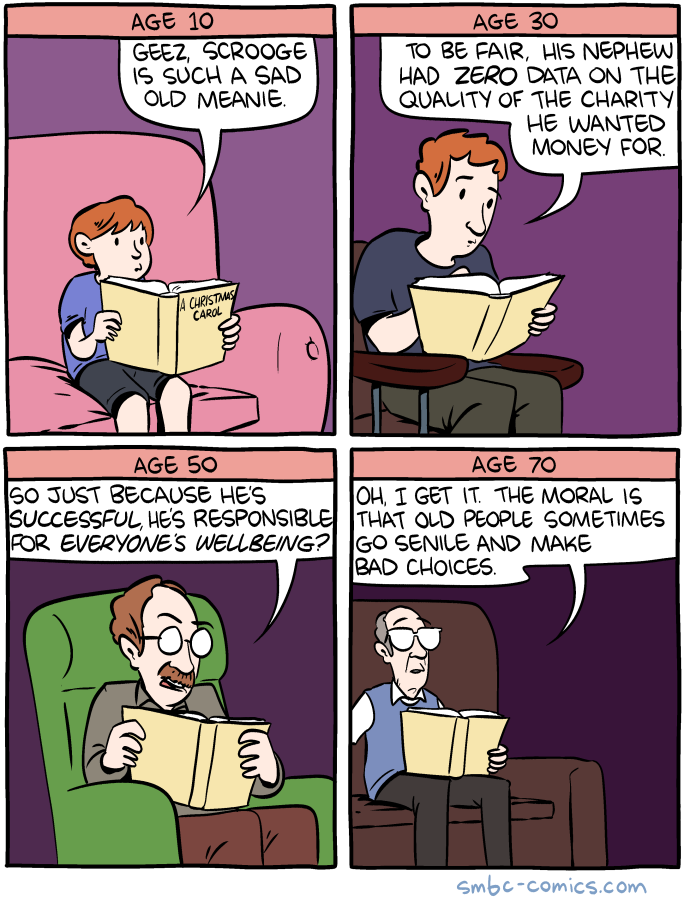
The comic presents a series of panels showing a person at different ages reading a newspaper and reacting to the story of Ebenezer Scrooge from "A Christmas Carol" with increasingly nuanced -- and increasingly cynical -- interpretations. At a young age, the reader sees Scrooge as simply "a sad old miser." As a teenager, the reader reframes it as Scrooge being "haunted with zero data on the ghosts'' credibility" -- questioning why Scrooge should trust supernatural visitors he has no reason to believe. At a later age, the reader observes that "just because he''s successful, his priorities become everyone''s problem."
The final panel delivers the punchline: "Oh, I get it. The moral is that old people sometimes make bad choices and also make good ones." This deliberately bland and obvious conclusion deflates all the clever reinterpretations that came before it, suggesting that over-analyzing a simple morality tale leads you right back to the most banal possible reading.
The Humor
The comic satirizes the tendency of people to develop increasingly sophisticated (and contrarian) readings of classic stories as they age and gain more education. Each new interpretation sounds cleverer than the last, but the final conclusion -- that people sometimes make good and bad choices -- is so obvious as to be meaningless. It pokes fun at the intellectual arms race of literary criticism, where each new reading tries to be more subversive than the previous one, only to eventually arrive at a truism.
It also works as a joke about how "A Christmas Carol" gets reinterpreted every generation, with each new era finding a way to make Scrooge either more sympathetic or more problematic, when the story is fundamentally quite simple.
References
- A Christmas Carol (1843) by Charles Dickens tells the story of Ebenezer Scrooge, a miserly old man who is visited by three ghosts on Christmas Eve and transforms into a generous, kind person. It is one of the most adapted and reinterpreted stories in English literature.