the-star-trek-problem

Explanation
The Joke
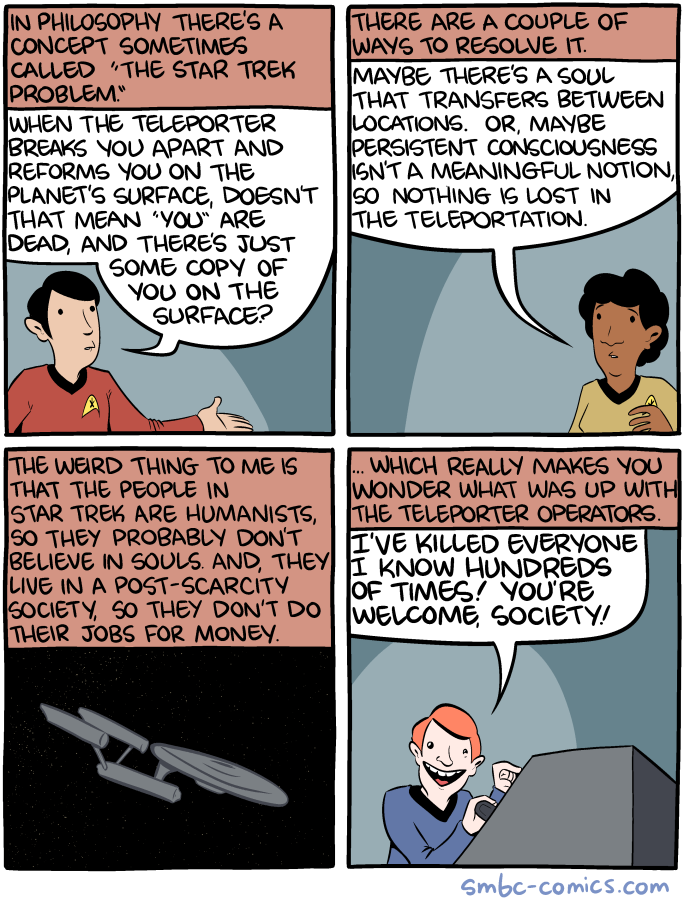
The comic discusses a philosophical concept it calls "The Star Trek Problem." A professor explains that in philosophy there is a thought experiment about teleportation: when a teleporter disassembles you at one location and reassembles you at another, it raises the question of whether the person who arrives is really "you" or just a copy, while the original "you" died. There are several ways to resolve this -- you might argue there is a real tension between identity and continuity, or that the concept of a persistent self is an illusion anyway, or that nothing is lost if the copy is perfect.
The professor notes that the weird thing is that this problem does not seem to bother anyone in the Star Trek universe. The characters live in a post-scarcity society, have conquered death through various means, and casually use teleportation daily without any existential angst. But then comes the punchline: "Which really annoys you if you''ve worried about it, and you sit up at night wondering..." followed by a person confessing, "I''ve killed everyone I know hundreds of times," to which the response is, "That''s it. You''re fine. Probably."
The Humor
The humor comes from the contrast between the profound philosophical implications of teleportation and the casual indifference of Star Trek characters toward it. The comic takes a well-known philosophical thought experiment and grounds it in the emotional reality of what it would actually feel like to grapple with it. The punchline -- someone realizing they may have "killed" everyone they know hundreds of times through routine teleporter use -- captures the horror that the show cheerfully ignores. The reassurance of "You''re fine. Probably" is perfectly inadequate.
References
The comic references the classic philosophical "teleporter problem," which is a variant of the Ship of Theseus and personal identity debates going back to John Locke and Derek Parfit. Parfit''s "Reasons and Persons" (1984) is particularly relevant, as he argued that what matters in survival is psychological continuity, not strict identity. The Star Trek transporter has been a popular vehicle for this thought experiment in philosophy of mind discussions. The comic also alludes to Star Trek''s post-scarcity economy and the show''s general lack of concern about the metaphysical implications of its own technology.